When a truck crash happens on black ice, trucking companies often move quickly to blame the weather instead of their driver. But icy roads do not automatically excuse careless or unsafe operation, and accepting that explanation too easily can cost injured victims financially. Federal safety rules require commercial drivers to slow down or stop when conditions become dangerous, and liability depends on whether those rules were followed before the crash occurred. If you were hurt in a collision involving a truck on icy roads, the issue is not simply whether ice was present. The issue is whether the driver ignored known winter risks and kept driving when the law required greater caution.
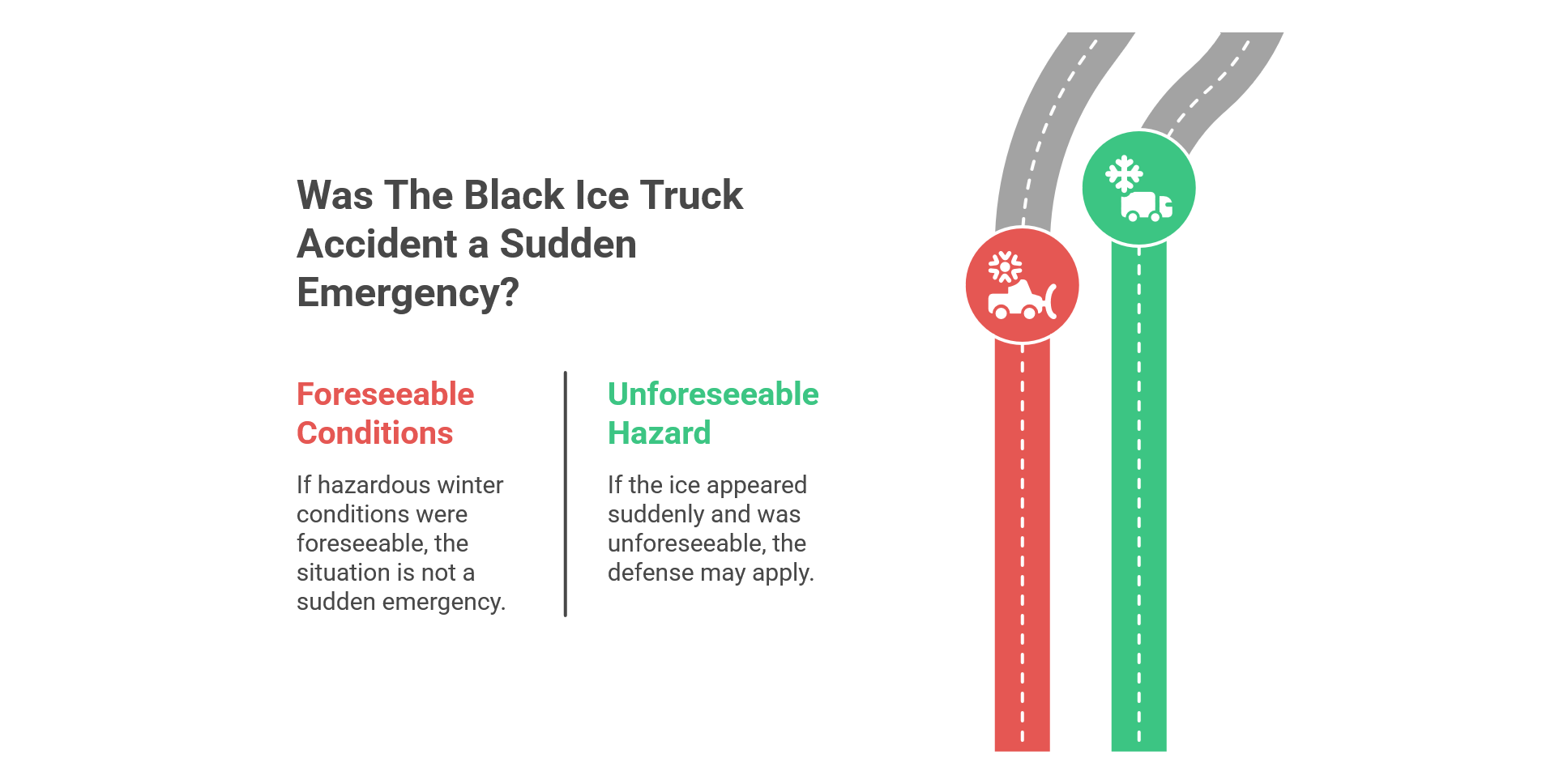
The sudden emergency doctrine is a defense sometimes raised after winter crashes to argue a driver should not be held responsible because an unexpected hazard made the collision unavoidable. Under Michigan law, it applies only if the situation was truly unforeseeable and not caused by the driver’s own conduct. Defense attorneys often cite black ice or rapidly changing weather, especially in highway or multi-vehicle incidents. Icy conditions are not legally “sudden” if evidence shows the driver should have anticipated them such as when temperatures were near freezing, advisories were issued, or road conditions indicated reduced traction. When winter hazards are foreseeable, the defense weakens because liability turns on how the driver responded to known risks, not simply on the presence of ice.
49 CFR 392.14: The Federal “Extreme Caution” Rule That Applies to Commercial Trucks
Commercial truck drivers must follow not only state traffic laws but also the Federal Motor Carrier Safety Regulations, which set nationwide safety standards for professional drivers. One of the most important winter-weather rules is 49 CFR 392.14, requiring commercial drivers to use extreme caution whenever hazardous conditions such as snow, ice, sleet, or reduced traction affect roadway safety. The regulation specifically instructs drivers to reduce speed when conditions worsen and to stop driving entirely if conditions become sufficiently dangerous.
49 CFR 392.14 requires commercial drivers to use extreme caution in hazardous conditions and to discontinue driving if conditions become unsafe. Continuing to operate a truck when traction is compromised can support a finding of liability.
Because heavy trucks require more time and distance to stop and are capable of causing far greater harm in a loss-of-control event, courts evaluate winter crashes involving commercial vehicles against this elevated federal duty of care. In liability analysis, the question is not simply whether weather was present, but whether the driver complied with the heightened safety obligations that apply specifically to commercial carriers.
Why Commercial Drivers Are Held to Higher Safety Standards
Commercial drivers are not treated the same as ordinary motorists because they operate vehicles that are significantly heavier, require longer stopping distances, and pose greater risk when traction is reduced. Federal law recognizes that operating a loaded commercial truck demands specialized training and stricter safety compliance. As a result, courts evaluate a truck driver’s conduct under a higher duty of care than the standard applied to passenger vehicle drivers. This distinction becomes especially important in black ice crashes, where reduced traction dramatically increases stopping distance and loss-of-control risk. Because professional drivers are trained to anticipate freeze-prone conditions and adjust speed accordingly, liability often turns on whether the driver accounted for those known winter hazards before the crash occurred.
Comparison of Legal and Operational Standards
| Factor | Passenger Vehicle (Ordinary Care) | Commercial Truck (Extreme Caution) |
|---|---|---|
| Legal Standard | Michigan Motor Vehicle Code | 49 CFR 392.14 |
| Stopping Distance | ~300 ft on dry pavement | ~500+ ft on dry pavement |
| Weight Impact | ~4,000 lbs | Up to 164,000 lbs (MI Max) |
| Weather Duty | “Adjust for conditions” | Must stop if sufficiently dangerous |
Commercial drivers operate under stricter federal rules because heavier vehicles require significantly more stopping distance and pose greater risk when traction is reduced.
When hazardous conditions arise, the law expects more from a trained commercial driver than from an ordinary motorist. The larger the vehicle and the greater the potential harm, the higher the duty to slow down or stop. Because of this elevated standard, liability after a winter truck crash is not measured solely by whether roads were icy. It is measured by whether the professional driver acted in compliance with the federal safety obligations designed specifically for heavy commercial vehicles.
How Telematics and Road Data Prove What Drivers Knew About Black Ice
Determining liability in a truck crash often depends on what the driver knew, or should have known, before losing control. Modern investigations rely on objective data, not assumptions about weather. Roadway sensor records, onboard truck systems, and time-stamped environmental reports can quickly establish whether freezing conditions were developing well before the collision. Because much of this evidence is stored electronically and may be overwritten or lost if not preserved promptly, identifying and securing it early can be critical.
RWIS Road Weather Information Systems
Michigan operates Road Weather Information Systems, known as RWIS, that monitor roadway conditions in real time. These systems measure pavement temperature, which can differ from air temperature, particularly on bridges and elevated surfaces. MDOT’s roadside sensor network tracks surface conditions, moisture levels, and freeze patterns along major highways. Since bridge decks cool faster than standard pavement, they often freeze first, creating predictable hazard zones that trained commercial drivers are expected to recognize. Accessing this data quickly can be important because archived roadway condition records may not be retained indefinitely.
Truck Electronic Data
Commercial trucks generate detailed operational records that can show how a vehicle was being driven before a crash. Electronic Logging Devices record location and driving time. GPS systems track speed and movement. Engine control modules may capture throttle input, braking activity, and other performance indicators. Together, these sources can reveal whether a driver slowed as conditions worsened or continued traveling at highway speed despite freezing risks. Because some electronic data can be overwritten during normal vehicle operation, delays in requesting it can mean losing key evidence.
Environmental Reconstruction
Investigators also analyze National Weather Service reports, hourly temperature trends, and precipitation patterns leading up to a collision. Temperature drops over time, freezing advisories, and reports of earlier crashes in the same area can all help establish whether icy conditions were foreseeable. When environmental data shows a sustained period of freezing weather, claims that ice appeared without warning become harder to support. Timely investigation matters here as well, since access to certain historical weather datasets and incident reports can become more limited as time passes.
Bridge Decks, Shadow Zones, and Other Predictable Freeze Points
Some roadway areas are widely known to freeze before others. Bridge decks and overpasses cool faster because they are exposed to air above and below, allowing surface temperatures to drop more quickly than standard pavement. Shaded highway segments can also remain icy longer due to limited sunlight. These locations create predictable freeze points, particularly when temperatures hover near freezing.
Commercial drivers are trained to anticipate these hazards and adjust accordingly. Because bridge decks, elevation changes, and shadowed areas are recognized risk zones, courts often examine whether the driver should have expected reduced traction in those areas. When a crash occurs at a known freeze-prone location, the argument that ice was entirely “unsuspected” becomes harder to support.
How Trucking Companies Defend Black Ice Cases
After winter truck crashes, defense teams often argue that weather, not driver conduct, caused the collision. Their goal is to frame the event as unavoidable by emphasizing how quickly road conditions can change and how little warning a driver supposedly had. These arguments focus on portraying the ice as sudden, invisible, and impossible to anticipate. Common defenses include claims such as:
- The ice appeared instantly
- The road looked dry moments earlier
- Conditions changed without warning
- The driver reacted as reasonably as anyone could
Whether these arguments succeed depends on the evidence. If weather data, roadway conditions, or vehicle records show that freezing risks were developing beforehand, the issue shifts from whether ice existed to whether the driver should have anticipated it and adjusted accordingly.
How Black Ice Defenses Are Challenged in Court
Courts do not evaluate black ice defenses based on statements alone. They examine objective evidence to determine whether the conditions were truly unexpected or whether a professional driver should have anticipated them. The central issue is foreseeability. If weather reports, roadway data, or prior incident records show freezing risks were developing before the crash, the claim that the hazard appeared suddenly becomes less persuasive.
In winter crash litigation, liability rarely turns on the presence of ice. It turns on whether the driver recognized the risk in time and responded the way federal safety standards require.
Evidence commonly used to challenge these defenses includes weather and roadway records showing freezing conditions beforehand, speed analysis compared to traction conditions, proof the driver failed to slow down, electronic data that contradicts driver statements, and documentation showing violations of federal safety rules. When this evidence demonstrates that hazards were predictable or that required precautions were not taken, the focus shifts from weather to driver responsibility.
Why Weight and Stopping Distance Matter in Winter Truck Crashes
Physics plays a major role in winter truck accidents because commercial vehicles weigh far more than passenger cars and carry substantially greater momentum at highway speeds. Heavier vehicles require more braking force and longer distances to slow down, even in good conditions. When ice reduces tire traction, stopping distances increase significantly because the friction needed for braking is limited, making it harder for a driver to reduce speed or avoid a hazard in time.
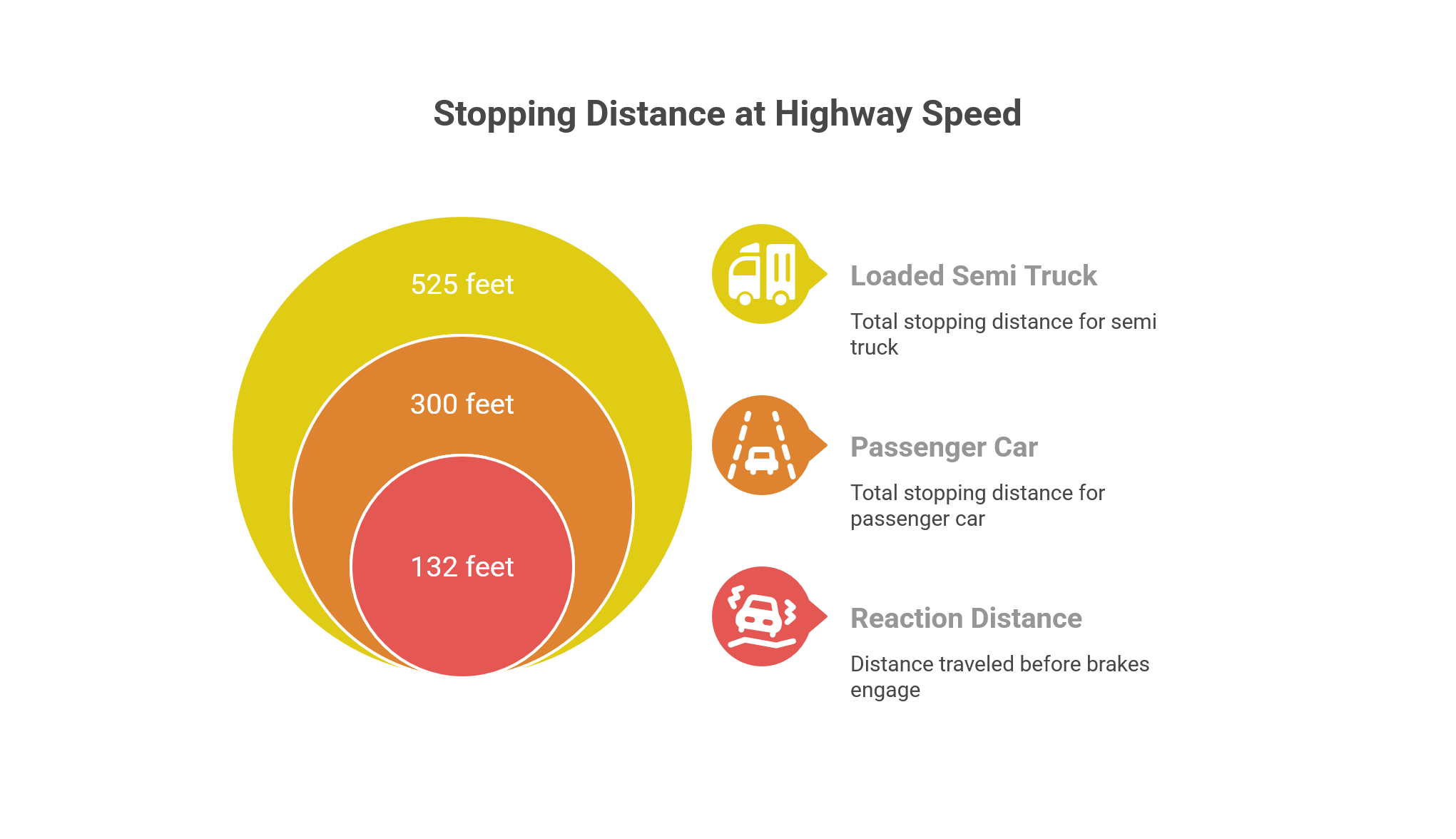
Reaction time further affects stopping ability. Even a brief delay before braking can add considerable distance when a large truck is traveling at speed, and that distance increases when traction is poor. In crash analysis, the key question is often whether the driver accounted for these physical limits as conditions worsened, not simply whether ice was present when the collision occurred.
The PIP Cap Reality: Why Proving Negligence Matters Financially
Michigan’s No-Fault system provides Personal Injury Protection coverage to pay medical expenses after a crash, but most policies now carry coverage limits instead of unlimited benefits. These tiers can leave injured drivers responsible for substantial medical bills once their selected coverage is exhausted. In serious truck accidents involving traumatic injuries, treatment costs can quickly exceed standard PIP limits, especially when ongoing care, rehabilitation, or long-term assistance is required.
For example, imagine a driver suffers a traumatic brain injury after a semi-truck loses control on icy pavement and strikes their vehicle. If that driver selected a $250,000 PIP limit, those benefits could be depleted within weeks due to hospitalization, surgery, and rehabilitation costs. If the trucking company successfully argues the crash was unavoidable because of weather, the injured person may have no access to additional compensation. But if evidence shows the truck driver failed to follow required safety precautions, proving negligence can allow recovery of excess medical expenses beyond the PIP cap, which can be critical for covering long-term care.
Why a Police Report Listing “Hazardous Weather” Does Not End the Legal Analysis
Police crash reports serve an important purpose, but they are not final determinations of legal fault. Officers document conditions, gather initial statements, and identify possible contributing factors, yet their role is investigative rather than judicial. When a report lists “hazardous weather” or similar language, it typically reflects observed road conditions at the scene, not a legal conclusion that no driver was responsible.
Legal liability is determined through a broader analysis that goes beyond the officer’s narrative. Courts and investigators may review additional evidence such as vehicle data, weather records, roadway sensor information, driver logs, and expert reconstruction findings. Even when weather is noted in a report, that does not resolve whether a driver acted reasonably under the circumstances or complied with applicable safety standards.
The 48-Hour Evidence Window: Why Early Investigation Is Critical
In truck accident cases, some of the most important evidence exists only for a short time. Electronic data can be overwritten during normal vehicle operation, onboard systems may store limited historical records, and third-party data sources may not retain information indefinitely. Without prompt action, key details about speed, braking, road conditions, and driver activity can disappear before they are ever reviewed.
Early investigation helps preserve evidence such as engine control module data, telematics records, roadway sensor information, vehicle condition, and dispatch communications. Trucks may be repaired or returned to service quickly, which can alter physical evidence, and digital systems can automatically replace older data with new entries. Securing this information as soon as possible is often essential to reconstructing what actually happened and determining whether the driver complied with required safety standards.
Key Evidence Investigators May Review After a Black Ice Truck Crash
Determining what caused a winter truck crash often requires examining multiple sources of physical, digital, and environmental evidence. Investigators look beyond surface conditions to identify whether the driver, vehicle, or operating decisions contributed to the collision. Key evidence may include:
- Onboard truck electronic data showing speed, braking, throttle input, and timing
- Driver qualification file documenting training, certifications, and driving history
- Maintenance logs revealing brake condition, tire status, and mechanical issues
- Weather records establishing temperature trends and freezing conditions
- Pavement sensor data indicating roadway surface temperatures and moisture levels
- Dash camera footage capturing real-time driving conditions and driver response
- Dispatch communications showing instructions, route pressure, or schedule demands
When analyzed together, these records can reconstruct the conditions leading up to the crash and clarify whether the incident resulted from unavoidable weather or from decisions that failed to account for known winter hazards.
Frequently Asked Questions About Black Ice Truck Accidents
Is a truck driver automatically not at fault if the road was icy?
No. Ice alone does not determine liability. Courts examine whether the driver adjusted speed, followed safety regulations, and responded appropriately to foreseeable winter conditions.
Can a trucking company still be responsible if weather caused the crash?
Yes. Even in poor weather, commercial drivers must follow federal safety rules requiring extreme caution. If evidence shows the driver failed to slow down or stop when conditions became dangerous, liability may still apply.
How can you prove a black ice crash was preventable?
Investigators may use weather records, pavement sensor data, truck electronic logs, and speed analysis to determine whether freezing conditions existed before the crash and whether the driver adjusted accordingly.
Does black ice affect compensation after a truck accident?
It can. Insurance companies often argue weather caused the crash to reduce liability. If that argument succeeds, compensation may be limited. If it fails, injured victims may be able to recover damages beyond their own insurance coverage.
What should I do if I was hit by a truck on icy roads?
Seek medical care, document what you can, and preserve evidence as soon as possible. Important data from trucks and roadway systems may only be stored for a limited time, so early investigation can be critical to determining what actually happened.
The Real Legal Question After a Black Ice Truck Crash
After a winter truck accident, the focus should not be on whether ice existed, but on whether the commercial driver complied with the higher safety standards required by federal law. Courts examine whether the hazard was foreseeable, whether speed was reduced appropriately, and whether the driver acted with the extreme caution mandated for heavy commercial vehicles. The issue is not the presence of ice. The issue is whether a trained professional responded to known winter risks in a way the law requires. For readers who want a broader explanation of how liability and compensation work in these cases, understanding how Michigan truck accident claims are evaluated can provide important context.

- When Black Ice Is Not a Legal Defense for Truck Drivers in Michigan - February 25, 2026
- Why Unlimited PIP Is the Only Real Choice for Michigan Families in 2026 - February 23, 2026
- What Happens If a State Employee Is Injured on the Job in Lansing? - February 18, 2026