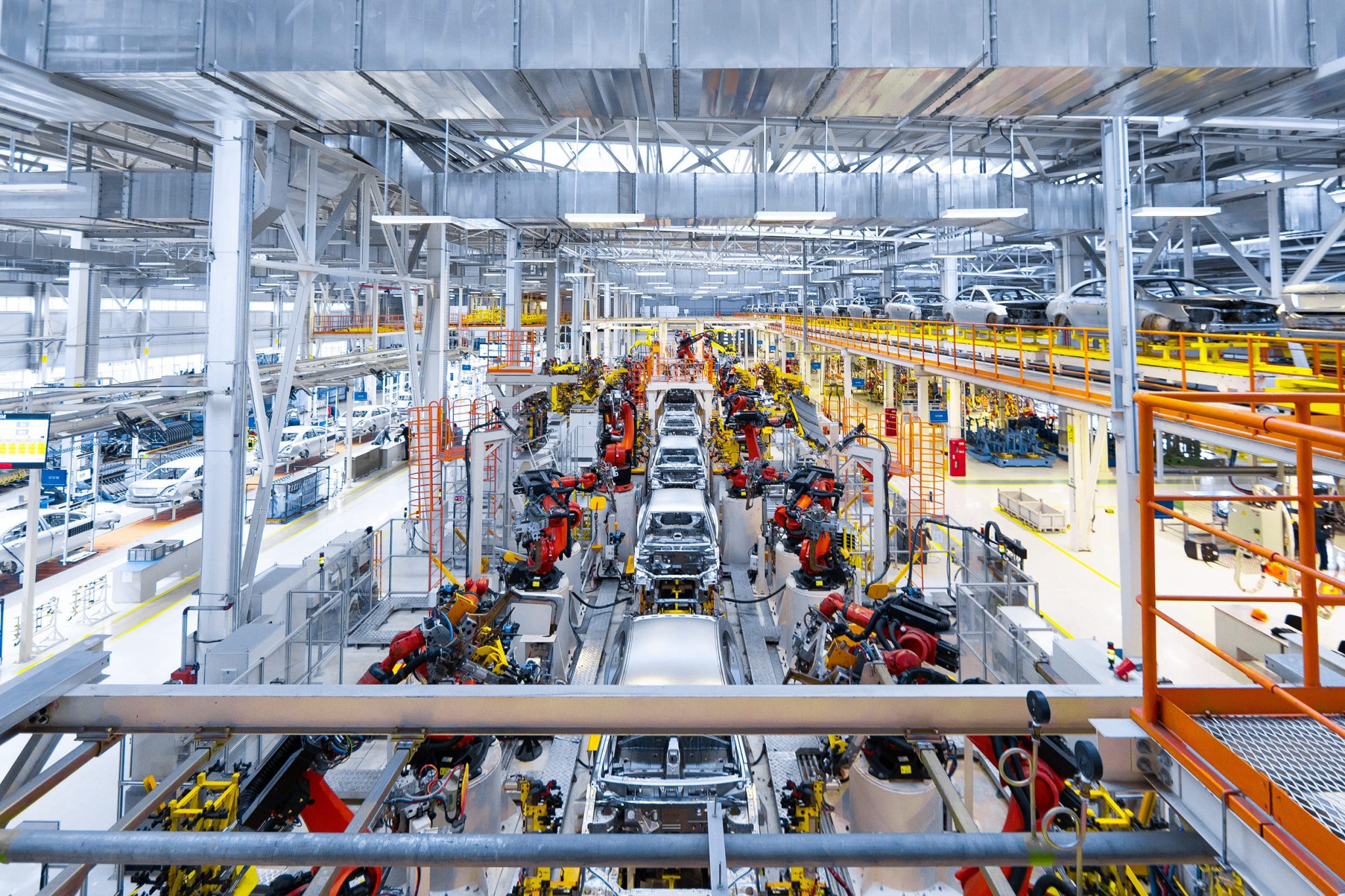
Wide view of an automotive factory assembly line with multiple cars being assembled by robotic arms in a bright, modern industrial setting.

This case involved a catastrophic workplace injury caused by defective industrial machinery and a manufacturer that initially denied the possibility of any defect. The matter required extensive expert analysis, prolonged discovery disputes, and investigation into corporate records across multiple jurisdictions before the full scope of the defect and prior injuries was uncovered.

The case ultimately resolved for $2.1 million after the manufacturer’s initial refusal to accept responsibility.

Case Overview

The plaintiff was working at an automotive machine parts plant when he suffered a severe injury while operating an industrial metal-forming machine. The machine required the operator to place a metal piece onto a mandrel using his left hand, after which the machine would engage and complete a forming cycle.

On the incident in question, the machine engaged prematurely while the operator was positioning the part. The machine either malfunctioned or double-clutched, engaging before the operator had withdrawn his hand. Once engaged, the machine would not disengage, forcing the operator’s hand to cycle fully through the metal-forming process.

The incident resulted in a crushing injury to the plaintiff’s left hand.

The Central Product Defect Issue

The core issue in this case was whether the machine was defectively designed or manufactured in a way that allowed it to engage unexpectedly and without adequate safeguards.

The machine manufacturer maintained that early engagement or double clutching could not occur and that the machine was functioning as designed. According to the defense, the machine was “generic” equipment used for many applications, and therefore could not be equipped with specific safety mechanisms tailored to any particular use.

If accepted, this position would have eliminated liability entirely.

Defense Position and Risk Factors

The manufacturer asserted several defenses that posed significant risk to the case, including claims that:

  • The machine could not double-clutch or engage prematurely
  • No feasible safety mechanism could be installed due to the machine’s generic design
  • The manufacturer had no knowledge of the machine’s end use
  • The manufacturer had no history of similar injuries

These defenses, if left unchallenged, would have supported the argument that the injury resulted from operator error rather than a product defect.

Investigation and Discovery Strategy

The case required extensive expert involvement and aggressive discovery efforts to test the manufacturer’s claims.

Through expert analysis, multiple discovery motions, and proceedings that included review by the Michigan Court of Appeal, evidence was obtained contradicting the manufacturer’s assertions. Discovery revealed that the manufacturer had knowledge of numerous prior left-hand crushing injuries involving the same or substantially similar machines.

Further investigation uncovered that the various companies responsible for manufacturing the machine and its component dies were not independent entities, but subsidiaries owned by a single multinational corporation. Corporate records showed that the manufacturer had received a large order for a specific part, undermining its claim that it had no knowledge of how the machine would be used or what safety mechanisms were feasible.

The discovery process also demonstrated that prior injury information had not been truthfully disclosed by defense experts, further weakening the manufacturer’s position.

Resolution and Outcome

Prior to litigation, the manufacturer offered no compensation. After case evaluation, the highest offer increased to $67,000.

Following continued discovery and development of evidence establishing prior injuries, corporate knowledge, and misrepresentation of risk, the case resolved for $2.1 million.

The settlement reflected the severity of the injury, the defective nature of the machine, and the manufacturer’s failure to implement or disclose necessary safety measures.

Why This Case Matters

This case illustrates how product liability claims involving industrial machinery often depend on uncovering information that is not voluntarily disclosed. Manufacturers may deny defects, minimize prior injuries, or rely on complex corporate structures to distance themselves from responsibility.

The outcome demonstrates the importance of persistence in discovery, expert analysis, and investigation beyond initial disclosures. Additional examples of how complex injury and product liability cases are handled can be found in our personal injury case studies hub.

Past results do not guarantee future outcomes. Each case is different and must be evaluated on its own facts and circumstances.

5/5 - (1 vote)