
An injury can disrupt everyday life quickly, especially when medical care, insurance issues, and uncertainty all surface at the same time. Many people feel pressure to act fast without fully understanding which early decisions actually matter and which assumptions can quietly create problems later.
This guide is designed to help injury victims in Lansing understand the broader landscape that follows an accident. Rather than focusing on one specific type of injury, it explains why early documentation, medical records, and insurance interactions often shape outcomes long before a claim is resolved.
As part of that overview, the visual guide below focuses specifically on the early steps many people face immediately after an accident. The sections that follow explain how those early moments fit into the larger picture and why local context matters.
A Visual Guide to Early Steps After an Accident in Lansing
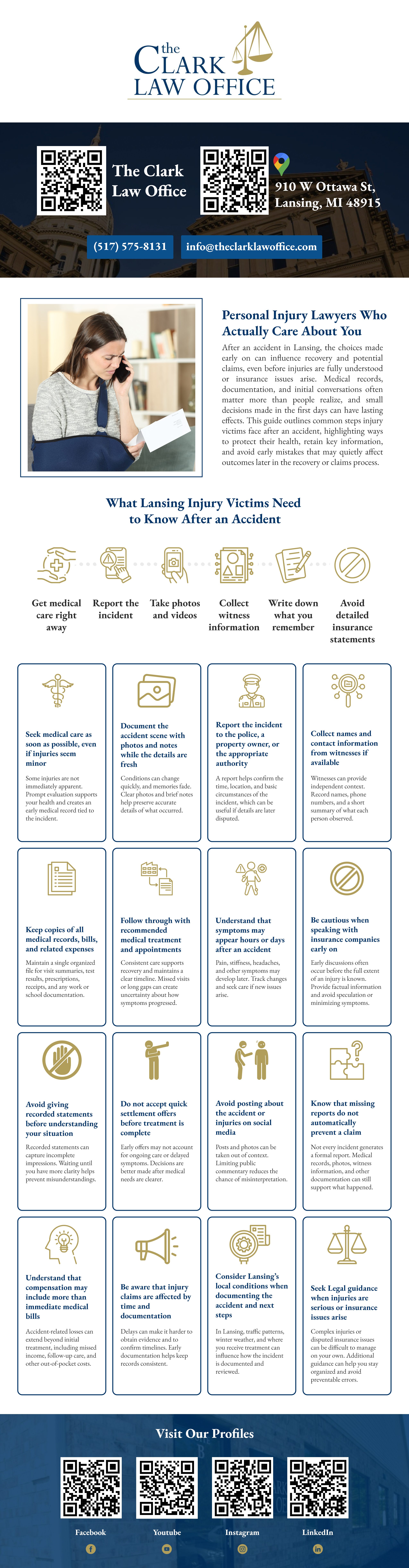
What to Do After an Accident in Lansing: A Clear Guide to Next Steps
This infographic highlights common early considerations after an accident, including medical care, documentation, and insurance caution. It is meant to provide a quick visual reference, not a substitute for understanding how injury claims develop over time.
How Early Decisions Shape Injury Claims in Lansing
In practice, early assumptions in Lansing injury cases are often unreliable. Medical care is delivered quickly, records are created across different settings, and insurance companies begin forming positions before the full impact of an injury is clear. By the time concerns surface, documentation has already been created and initial narratives may already be in place.
Medical treatment plays a central role in this process. Seeking care promptly helps protect health and creates a record connecting injuries to the accident. Just as important is consistency. Gaps in treatment, delayed follow-up, or incomplete reporting can complicate how injuries are later evaluated, even when symptoms were real and serious.
Documentation created early often carries more weight than people expect. Records reflect what providers observed at the time, not what becomes clear later. Understanding that reality helps explain why early steps can matter long after the initial shock of an accident fades.
How Insurance and Documentation Quietly Influence Outcomes
Insurance involvement often begins before recovery is fully understood. Adjusters may request statements or information that feels routine but later becomes significant. Early conversations can shape how injuries are framed, particularly when symptoms develop gradually.
Quick settlement offers are another common pressure point. These offers are typically made before treatment is complete and before future limitations are known. Accepting early resolution may close the door on addressing complications that appear weeks or months later.
Even everyday actions can influence how claims are evaluated. Casual comments, inconsistent descriptions of pain, or social media activity can be misinterpreted when taken out of context. These issues do not automatically defeat claims, but they often complicate them.
What Compensation Reflects After a Serious Injury
Compensation in an injury case is intended to address the overall impact of an accident, not just immediate expenses. Medical bills and missed income are often the most visible losses, but they are rarely the full story.
In many cases, injuries affect daily function, work capacity, and quality of life in ways that unfold over time. Ongoing treatment, physical limitations, and future care needs may not be clear at the outset. This is why early evaluations can change as recovery progresses and why documentation throughout treatment remains important.
Understanding compensation as a reflection of long-term impact helps set realistic expectations and explains why injury claims are rarely resolved responsibly before the full scope of recovery is known.
Why Local Context Matters for Lansing Injury Victims
Injury claims do not exist in a vacuum. Local conditions often influence how accidents occur and how claims are evaluated. In Lansing, traffic patterns, seasonal weather, construction corridors, and pedestrian activity all shape common accident scenarios.
Medical care is another important local factor. Injury victims in Lansing frequently receive treatment through providers such as University of Michigan Health Sparrow, McLaren Greater Lansing, urgent care centers, and specialty practices throughout Mid-Michigan. Understanding how records, referrals, and follow-up care typically flow through these systems helps reduce confusion during recovery.
Insurance practices can also vary by region. Familiarity with how claims are commonly handled locally allows injury cases to be evaluated with fewer surprises. Local knowledge does not change the law, but it often affects how smoothly the process unfolds.
Lansing Injury Cases This Guide Commonly Applies To
The issues discussed in this guide arise across many types of injury cases in Lansing. While each practice area follows different legal rules, early medical documentation, insurance communication, and timing often influence outcomes regardless of how an injury occurred.
These considerations are especially common in Lansing personal injury cases, where multiple factors can affect how claims develop. Similar issues arise in Lansing car accident claims, motorcycle accident injuries, and truck accident cases, where early records and insurance positions often shape the direction of a claim.
Early decisions also matter in Lansing dog bite cases and slip and fall accidents, where responsibility is frequently disputed and conditions may change quickly. In more complex matters, including Lansing medical malpractice claims, birth injury cases, and wrongful death claims, documentation, timing, and expert review often determine whether a claim can move forward at all.
Using This Guide as You Decide What to Do Next
This page is designed to inform rather than pressure. Not every injury leads to a claim, and not every situation requires legal involvement. Understanding how early decisions affect injury cases in Lansing helps individuals decide what steps make sense based on their circumstances.
The visual guide above offers a snapshot of early considerations. The surrounding sections explain why those steps matter and how they fit into the larger process. Together, they are meant to help injury victims move forward with clarity rather than assumptions.
Frequently Asked Questions from Lansing Injury Victims
Do I have to talk to the insurance company after an accident?
You are generally required to notify your own insurance company that an accident occurred, but you are not required to give a detailed or recorded statement to the other party’s insurer right away. Early conversations can be misunderstood, especially before medical treatment is complete. It is usually best to understand your situation before answering detailed questions.
What if I feel fine at first but get hurt later?
Many injuries do not cause immediate symptoms. Pain, stiffness, headaches, or other issues can appear hours or days after an accident. This is one reason medical evaluation and follow up care are important, even when injuries seem minor at first.
Can I still recover compensation if I was partly at fault?
In many situations, being partially at fault does not automatically prevent an injury claim. Responsibility is often shared, and compensation may still be available depending on the circumstances and how fault is determined.
What if there is no police or incident report?
A report can be helpful, but it is not required in every case. Medical records, photos, witness statements, and other documentation can still support an injury claim even if no formal report exists.
How long does an injury claim usually take?
The timeline varies widely. Some claims resolve in a few months, while others take longer depending on the severity of injuries, length of treatment, and whether disputes arise. Claims are often clearer once medical recovery is better understood.
Should I accept the first settlement offer?
Early settlement offers are often made before the full impact of an injury is known. Once an offer is accepted, it is usually final. It is important to understand future medical needs and other losses before making a decision.
What evidence matters most in an injury claim?
Medical records are often the most important evidence. Photos, witness information, treatment notes, and documentation of how an injury affects daily life can also play a meaningful role.
What if my injury affects my ability to work?
Injuries that limit your ability to work can affect more than just immediate paychecks. Reduced hours, missed opportunities, or long term limitations may all be relevant when evaluating how an injury has impacted your life.
When should I consider getting legal help?
Legal guidance is often helpful when injuries are serious, recovery is prolonged, or insurance issues become difficult to manage. Speaking with someone early can help clarify options and prevent avoidable mistakes.
Resources for Lansing Injury Victims
- Michigan State Police
- Michigan Department of Insurance and Financial Services
- University of Michigan Health Sparrow
- McLaren Greater Lansing
- Ingham County Health Department
These resources are provided for general informational purposes to help injury victims better understand medical care, reporting, and insurance considerations.