
Dog bite injuries in Lansing are governed by specific Michigan laws that differ from most other personal injury claims. Under Michigan law, dog owners can be held legally responsible for bite injuries even if the dog has never bitten anyone before. That strict liability framework means many dog bite cases turn less on intent or prior behavior and more on whether the injured person was lawfully present and whether the bite occurred without provocation.
Despite that clarity in the law, dog bite claims are often misunderstood in practice. People frequently assume they need to prove the dog was dangerous, that the owner acted recklessly, or that pursuing a claim requires confrontation or hostility. In Lansing, those assumptions often delay medical documentation, complicate insurance coverage questions, and create uncertainty about what options actually exist.
“Most people don’t realize that Michigan’s dog bite law removes many of the hurdles they think they face. The problem is that misunderstandings early on can quietly affect medical records, insurance decisions, and how the claim is framed before anyone explains how the law actually works.” – Matthew R. Clark
At The Clark Law Office, Lansing dog bite cases are evaluated based on how Michigan law applies to the specific facts of the incident, not on myths about one-bite rules or assumptions about fault. Our local Lansing injury attorneys focus on whether the legal elements are met, how injuries are documented, and how insurance coverage applies under the circumstances present in Lansing dog bite cases.
This page explains how dog bite claims actually work in Lansing, what must be shown under Michigan law, and why early assumptions often cause confusion. It is written for injured individuals who want clear, realistic information before deciding whether legal guidance would be helpful and how to move forward with a better understanding of their situation.
Why Dog Bite Claims in Lansing Are Often Misunderstood
Many people hesitate to take action after a dog bite because the situation feels uncomfortable or unclear. They may worry about harming a relationship, overreacting, or pursuing something that does not feel “serious enough” at the moment. That hesitation is common, but it often stems from misunderstandings about how dog bite claims actually work.
Dog bite cases are frequently misunderstood because they involve overlapping issues, such as:
- assumptions about whether the dog had bitten before
- uncertainty about insurance coverage
- confusion about whether fault or intent matters
- concern about consequences for the dog or owner
In Lansing, these misconceptions often delay proper evaluation of the injury and the claim. By the time questions are clarified, important medical or insurance issues may already be in motion. Understanding why these cases are misunderstood can help injured individuals recognize when clarity matters more than discomfort.
How Michigan’s Dog Bite Laws Apply in Lansing
Michigan has one of the strongest dog bite statutes in the country. Under state law, a dog owner can be held responsible for injuries caused by their dog even if the dog has never bitten anyone before and even if the owner believed the dog was not dangerous. The focus is not on the dog’s history, but on whether the injured person was lawfully present and whether a bite occurred.
Michigan’s dog bite law (MCL 287.351) holds owners responsible even if the dog has never bitten before. Lansing dog bite claims focus on whether a bite occurred, where it occurred, and whether insurance coverage applies, not the dog’s past behavior.
In Lansing dog bite cases, the concept of lawful presence is often central. Lawful presence generally includes situations where someone is invited onto property, conducting legitimate business, or otherwise allowed to be where the bite occurred. Trespassing can change how the law applies, but most everyday situations involving guests, neighbors, delivery personnel, or children fall within lawful presence.
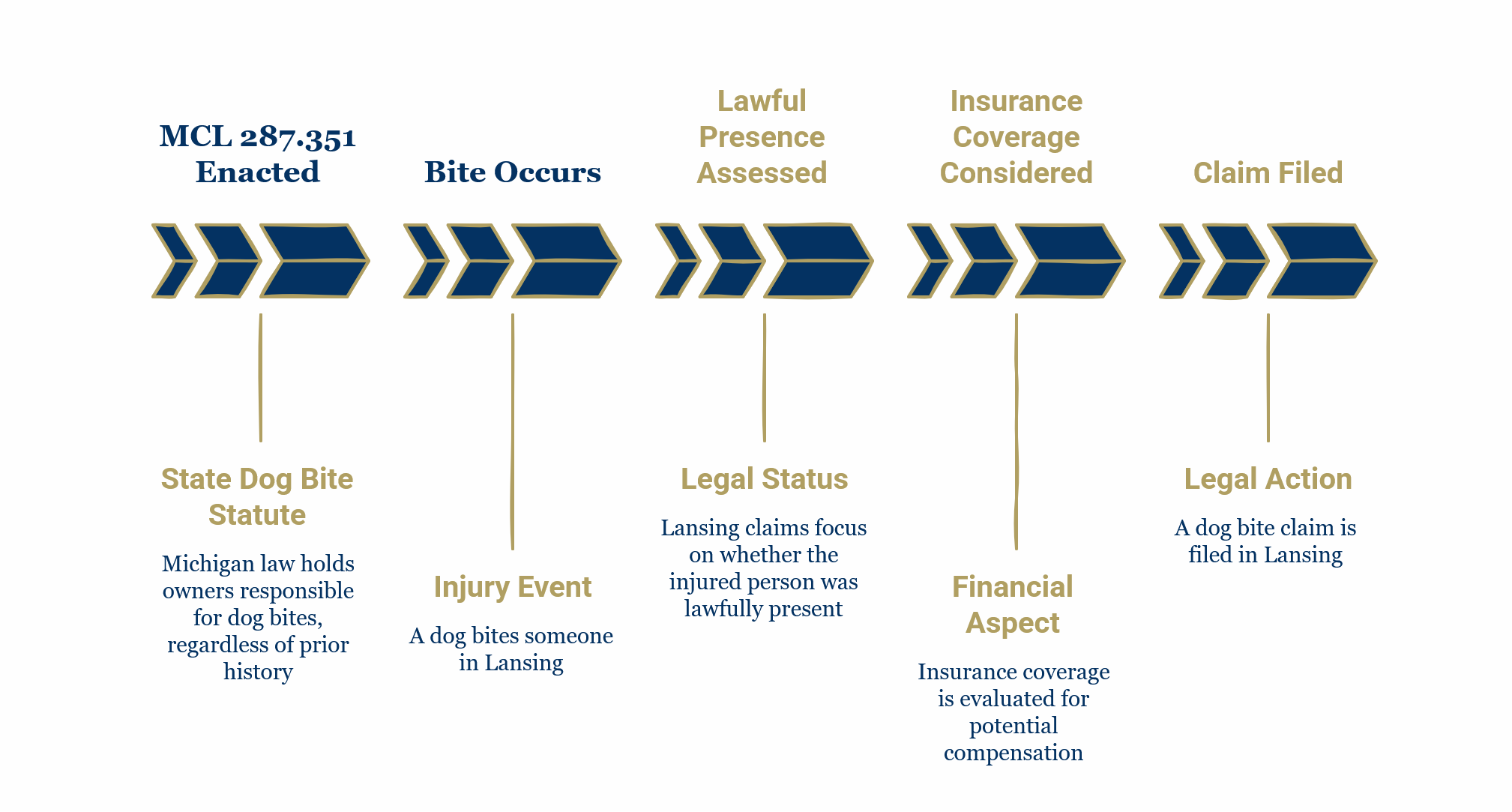
Because Michigan’s dog bite law operates differently than general negligence rules, dog bite claims should not be evaluated using assumptions drawn from other injury cases. Understanding how the statute applies locally helps ensure the case is framed correctly from the beginning.
When a Dog Owner Is Legally Responsible for a Bite
Legal responsibility in a Lansing dog bite case is not based on whether the owner intended harm or acted carelessly at the moment. Instead, responsibility is determined by how Michigan law defines ownership, control, and the circumstances of the bite.
A dog owner may be legally responsible even if:
- the dog was normally well behaved
- the bite happened quickly or unexpectedly
- the owner was not present at the time
- the dog had no prior incidents
At the same time, certain facts can affect how responsibility is evaluated, such as provocation, trespassing, or disputes over who had control of the dog. These issues are often fact-specific and require careful evaluation rather than assumptions.
In Lansing, responsibility is best assessed by examining how the incident occurred and how the law applies to those facts, rather than relying on general beliefs about fairness or blame.
Dog Bites Involving Children, Guests, and Private Property
Dog bite cases in Lansing often arise in everyday settings involving people who had every right to be where they were. Whether the injured person is a child, a guest, or someone lawfully on private property, these cases are usually evaluated based on ownership, location, and lawful presence rather than assumptions about fault or risk-taking.
Understanding how Michigan’s dog bite law applies in these common scenarios helps clarify why many claims are valid even when the incident occurs in a familiar or private environment. The sections below address how these issues are typically analyzed in Lansing dog bite cases.
Dog Bites Involving Children
Dog bites involving children are among the most serious cases handled under Michigan law. Children are often less able to recognize risk or protect themselves, and injuries to the face, head, or hands can have long-term physical and emotional effects. In Lansing, dog bite claims involving children are evaluated with particular attention to injury severity and future impact.
Because children are rarely considered at fault in these situations, legal responsibility often focuses on ownership and lawful presence rather than behavior. Early medical documentation and careful evaluation are especially important in these cases.
Bites on Private Property or While Visiting
Many Lansing dog bites occur on private property while the injured person is visiting, socializing, or performing routine activities. In these situations, lawful presence is usually established through ordinary circumstances, such as being invited inside a home or yard.
Examples commonly include:
- visiting a friend or relative
- attending a social gathering
- being on the property with permission
- performing deliveries or services
Understanding how lawful presence is established helps prevent incorrect assumptions that a claim is barred simply because the bite occurred on private property.
Insurance Coverage Issues in Lansing Dog Bite Claims
Dog bite claims are often resolved through insurance rather than direct payment by the dog owner. In Lansing, homeowners and renters insurance policies frequently provide coverage for dog bite injuries, but that coverage is not always straightforward.
Coverage issues may arise when:
- the policy contains breed-related exclusions
- coverage limits are disputed
- multiple policies may apply
- insurers question whether the incident qualifies as a covered event
Insurance carriers often begin evaluating exposure early, sometimes before the injured person fully understands the extent of their injuries. Knowing how insurance coverage typically applies in Lansing dog bite cases helps explain why certain questions or delays occur.
When a Dog Bite Case Is More Serious Than It Appears
Not all dog bite injuries heal quickly or resolve without complication. Some cases involve injuries that require ongoing treatment or have lasting consequences that are not immediately apparent.
A dog bite case may be more serious when it involves:
- facial injuries or scarring
- nerve damage
- infections or complications
- injuries to children
In these situations, the legal and medical analysis often extends beyond short-term recovery. Evaluating long-term impact early helps ensure that the case reflects the full scope of the injury rather than only the initial treatment.
What to Consider Before Taking Action After a Lansing Dog Bite
After a dog bite, it is common to feel unsure about what steps actually matter. Medical treatment, reporting, and insurance communication may feel overwhelming, especially while injuries are still healing and emotions are running high. Many people worry about doing the wrong thing or missing something important without knowing what truly affects a claim.
Rather than reacting out of fear or pressure, it can be helpful to understand how dog bite claims typically develop in Lansing. Early decisions often shape medical documentation, insurance coverage, and how responsibility is evaluated later, even when their significance is not obvious at the time.
Taking a measured approach allows the situation to be evaluated based on facts and law rather than assumptions or urgency, helping preserve options while the full impact of the injury becomes clearer.
How Dog Bite Cases Are Evaluated at The Clark Law Office
Dog bite cases are rarely defined by a single moment. Medical information evolves, insurance positions change, and the long-term impact of injuries becomes clearer over time. For that reason, meaningful evaluation is an ongoing process rather than a one-time assessment.
At The Clark Law Office, Lansing dog bite cases are evaluated by examining how the injury occurred, how Michigan law applies, and how medical and insurance issues intersect. Preparation focuses on preserving flexibility rather than rushing conclusions.
This approach allows cases to develop deliberately and helps avoid decisions that narrow options before the full picture is understood.
Our Lansing Office
Our Lansing office provides a local point of contact for individuals dealing with dog bite injuries. Being based in Lansing allows cases to be evaluated with familiarity with local insurers, medical providers, and procedures that commonly affect injury claims. That local presence helps ensure dog bite cases are approached with context rather than assumptions.
“My experience working with Matt Clark has been excellent. He was compassionate and knowledgeable over the phone before even meeting him. He drove to me for the initial consult which made things easy. I was satisfied with the result of my accident case and would not hesitate to recommend him to family or friends. A huge thank you to Matt and The Clark Law Office.”
— S.J., Michigan
★★★★★ Google Review
How Lansing Dog Bite Claims Fit Into Broader Michigan Cases
While Lansing dog bite cases are shaped by local systems, they also operate within Michigan’s broader legal framework. Michigan dog bite cases across the state are governed by the same statutes, insurance practices, and court rules, even as local procedures influence how individual claims begin and develop.
Understanding how Lansing claims fit within the larger Michigan context helps ensure that cases are evaluated accurately, whether they resolve locally or involve broader considerations. This perspective allows local insight to inform strategy without losing sight of statewide legal standards.
Making Informed Decisions After a Lansing Dog Bite
Uncertainty is common after a dog bite injury. Questions about responsibility, insurance, and medical care often overlap, making it difficult to know what matters most. These challenges are not a sign that something has gone wrong, but a reflection of how dog bite claims typically unfold.
This page is intended to provide clarity rather than pressure. Understanding how Lansing dog bite cases work can help you recognize what factors affect your situation and decide whether legal guidance would be helpful. The goal is informed decision-making based on facts, law, and context.
Attorney Oversight by Matthew R. Clark
This page reflects how matters in this practice area are evaluated and handled at The Clark Law Office, based on direct attorney involvement and real-world experience with Michigan law, insurance issues, and litigation strategy.