
After a car accident in Michigan, the legal process usually begins with a no-fault insurance claim through your own insurer for medical expenses and wage loss benefits. If the injuries meet Michigan’s serious impairment threshold under MCL 500.3135, the injured person may also pursue a third-party lawsuit against the at-fault driver for additional compensation such as pain and suffering.
Michigan’s legal framework creates a multi-step process for evaluating accident claims. Victims must report the crash, document injuries, file insurance claims, and establish fault when liability is disputed. These steps can affect both the benefits available through no-fault insurance and the ability to pursue additional compensation from the responsible driver.
This guide explains how the legal process works after a crash, including what steps to take immediately after an accident, how fault is determined, how insurance claims are filed, and when legal representation may become necessary. For a detailed breakdown of the statutes governing these cases, see our page explaining Michigan car accident laws.
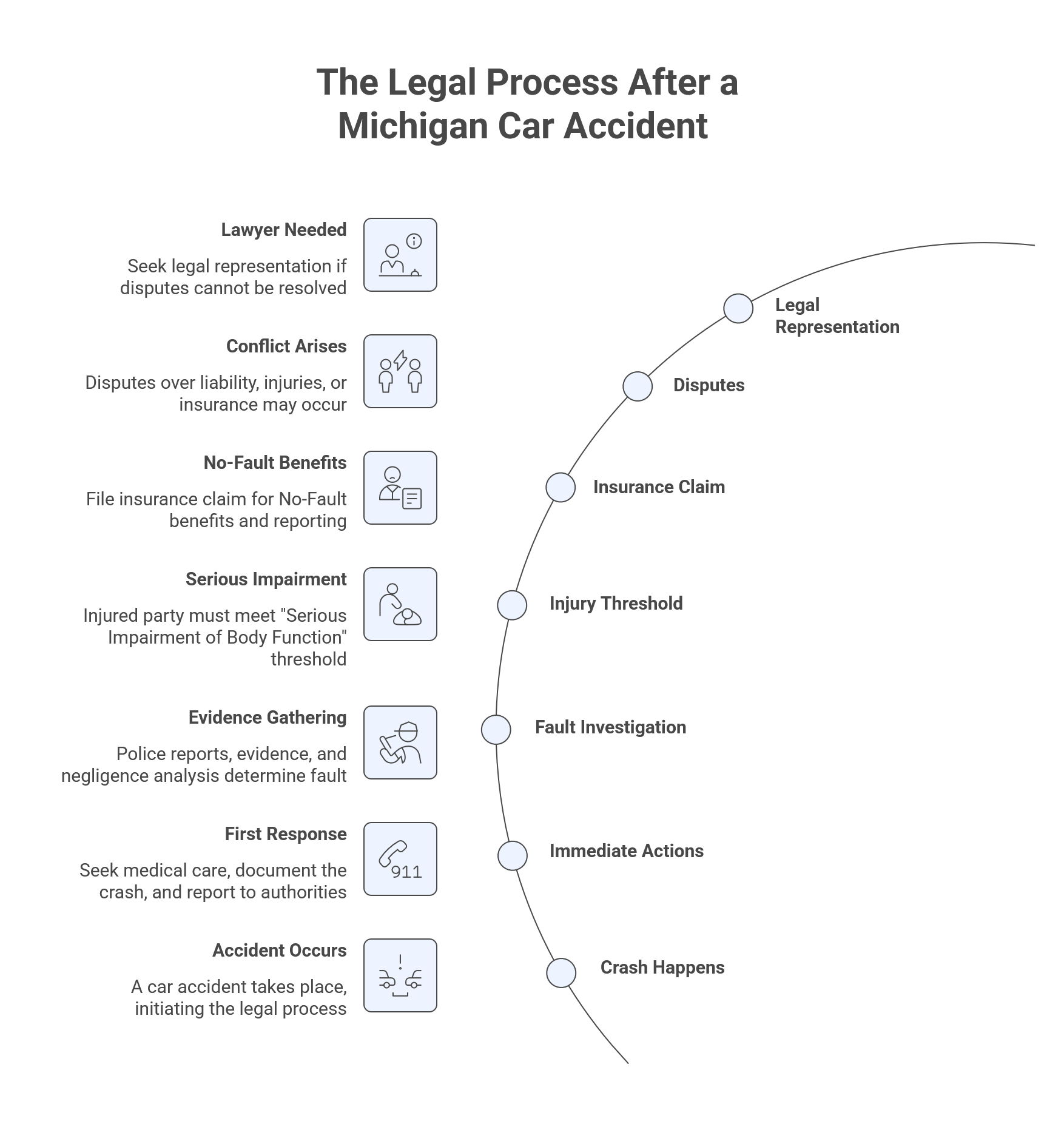
- Michigan uses a no-fault insurance system after car accidents.
- Pain and suffering requires a serious impairment of body function (MCL 500.3135).
- Fault is determined using evidence like police reports, witnesses, and crash data.
- Strict deadlines apply to insurance claims and injury lawsuits.
The steps taken immediately after a car accident can affect both safety and how an insurance claim or legal case is evaluated later. Taking the right actions at the scene helps preserve important evidence and can make it easier to determine what happened.
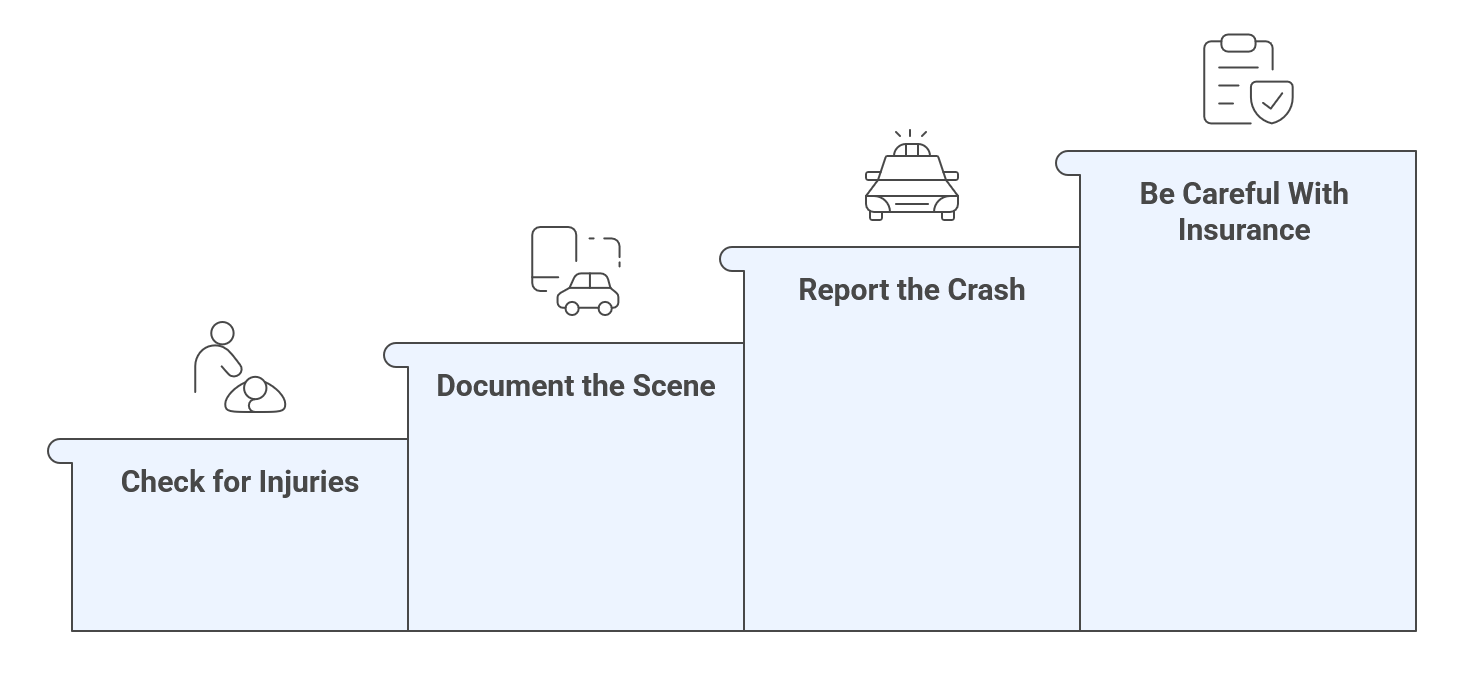
Prioritize Safety and Medical Care
Check for injuries and call emergency services if anyone needs medical attention. Even if injuries seem minor, documenting medical symptoms early can be important for both treatment and insurance claims.
Document The Accident Scene
Take photographs of vehicle damage, road conditions, traffic signals, and any visible injuries. Gathering this information immediately after the crash can help establish how the accident occurred. Our guide on what to do after a car accident explains these steps in greater detail.
Report the Crash When Required
In many situations, contacting law enforcement helps create an official record of the accident that insurance companies rely on when evaluating claims. Learn more about when reporting is necessary in do you need a police report after a car accident.
Be Cautious When Speaking With Insurance Companies
Insurance adjusters may request recorded statements shortly after a crash, sometimes before fault or injuries are fully understood. Understanding your rights before providing a statement can help avoid misunderstandings during the claims process. See should you give a recorded statement after a car accident for more guidance.
How Fault Is Determined After a Car Accident
Determining who caused a car accident is one of the most important steps in evaluating an injury claim. In Michigan, fault is determined by analyzing driver behavior, applying comparative negligence rules, and reviewing evidence from the crash. Investigators, insurance companies, and attorneys often evaluate several factors when determining liability.
Key Factors Used to Determine Fault in Michigan Car Accidents
| Factor | What It Means |
|---|---|
| Driver behavior | Actions such as speeding, distracted driving, failure to yield, or ignoring traffic signals often play a major role in determining who is at fault in a Michigan car accident. |
| Comparative negligence | Michigan follows a system of shared responsibility. Under comparative negligence in car accident cases, multiple drivers may share fault and compensation may be reduced according to each person’s percentage of responsibility. |
| Evidence from the crash | Police reports, witness statements, vehicle damage patterns, photos, and traffic camera footage are often used when proving negligence in a Michigan car accident claim. |
Bottom Line: Fault in Michigan car accident cases is determined by evaluating driver behavior, applying comparative negligence rules, and analyzing evidence from the crash.
The Injury Threshold Required to File a Lawsuit
Michigan’s no-fault insurance system limits when an injured person can sue the at-fault driver after a car accident. While medical expenses and certain financial losses are typically covered through no-fault benefits, a lawsuit for pain and suffering is only allowed if the injury meets the state’s legal threshold. Under MCL 500.3135, an injured person must generally prove that the crash caused a serious impairment of body function before pursuing non-economic damages against the responsible driver.
Courts evaluate whether an injury affects a person’s ability to live their normal life when applying this standard. The severity of the injury, how long it lasts, and how it impacts daily activities are all considered when determining whether the threshold is met. Understanding Michigan’s serious impairment of body function rule is essential because it determines whether an injured driver can pursue compensation beyond no-fault insurance benefits.
Filing an Insurance Claim After a Crash
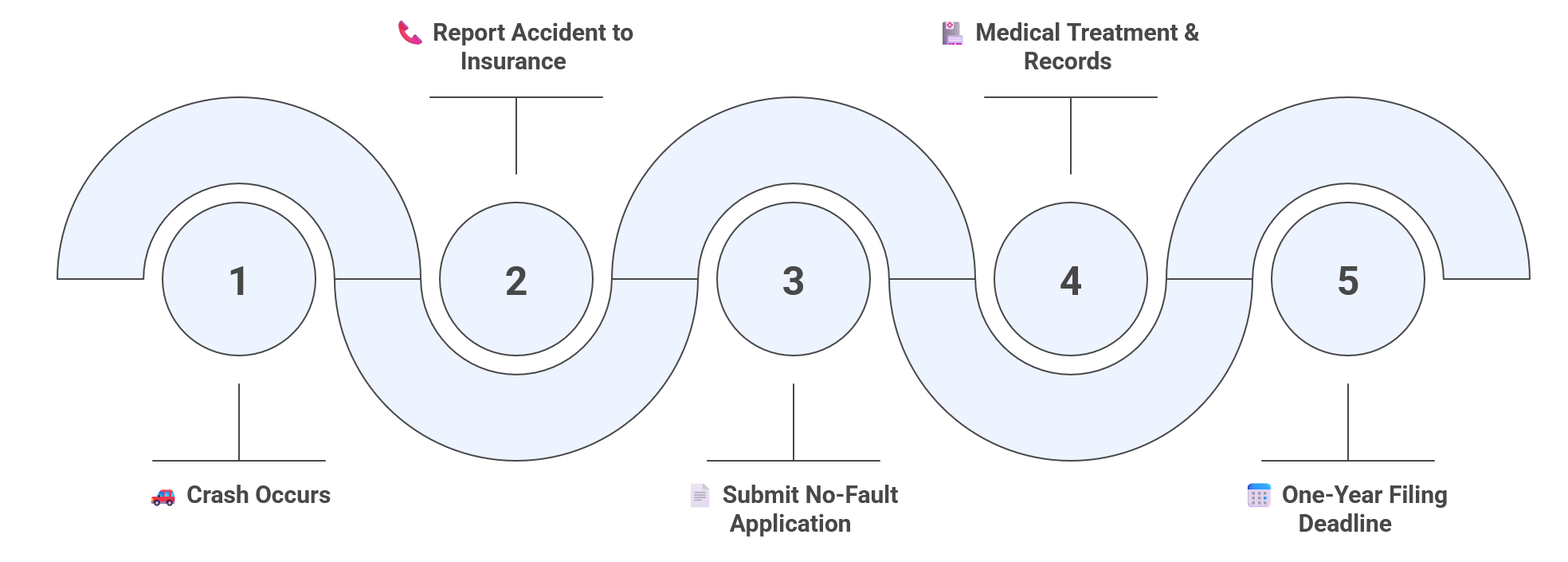
After a car accident in Michigan, injured drivers typically turn to their own insurance company for benefits under the state’s no-fault system. These benefits may include medical expenses, wage loss, replacement services, and other crash-related costs depending on the coverage selected under the policy. Reporting the accident to your insurer and beginning the claims process is an important step after a crash. Understanding how to file an insurance claim after a car accident can help ensure that required information and documentation are submitted properly.
Michigan law also imposes strict deadlines for seeking certain benefits after an accident. In many cases, injured drivers must file an application for no-fault benefits within one year of the crash in order to preserve their rights. Missing this deadline can affect the ability to recover medical expenses or other benefits. Knowing how long you have to file a car accident claim in Michigan is critical for protecting your legal options after a collision.
If disputes arise during the claims process, resolving the issue may require filing a lawsuit in Michigan’s civil court system. These cases follow a structured legal process that typically begins when a complaint is filed and the parties begin exchanging evidence through discovery. The basic steps involved in a Michigan lawsuit are outlined in this overview of how civil cases work in Michigan courts.
Common Disputes After a Car Accident
Even when a crash appears straightforward, disagreements can arise during the insurance and claims process. Disputes often involve conflicting statements, questions about liability, or disagreements about injuries and damages.
- Drivers giving conflicting accounts of how the crash occurred
- Insurance companies disputing who was at fault
- Disagreements about whether injuries were caused by the accident
- Disputes over the severity of injuries or necessary medical treatment
- Drivers changing their story after the collision
- False or misleading statements about the accident
Bottom line: When the facts of a crash are disputed, understanding what to do if the other driver lies about the accident can help protect your claim and ensure important evidence is preserved.
When You May Need a Car Accident Lawyer
Not every crash requires legal representation, but certain situations make it much more important to speak with an attorney.
- Serious injuries that may meet Michigan’s injury threshold
- Disputed fault or conflicting accounts of the crash
- Insurance companies denying or delaying benefits
- Settlement offers that do not cover medical bills or lost income
- Accidents involving multiple drivers or complex liability issues
Understanding how to choose a Michigan car accident lawyer can help you evaluate experience and representation options if your case becomes complicated. If you have already hired an attorney but feel the representation is not meeting your expectations, it may also be helpful to understand when you can fire your car accident lawyer and select new counsel.
Understanding Michigan Car Accident Laws
Michigan car accident claims are governed by a detailed set of statutes that regulate no-fault insurance benefits, liability rules, and the legal standards for pursuing compensation after a crash. These laws determine how benefits are paid, when lawsuits are allowed, and what deadlines apply to injury claims. For a deeper explanation of the legal framework that governs these cases, see our overview of Michigan car accident laws.
Explore Related Michigan Car Accident Guides
These guides explain crash types, injuries, insurance rules, and compensation issues that often affect Michigan car accident claims.
Common Types of Car Accidents in Michigan
See how different crash scenarios affect liability, fault analysis, and injury claims.
Common Car Accident Injuries in Michigan
Understand the injuries most often involved in serious Michigan auto accident cases.
Michigan Car Accident Claims and Compensation
Learn how damages are calculated and what factors influence the value of a claim.
Michigan Car Accident Insurance and No-Fault Guide
Understand how Michigan no-fault insurance works and which coverage may apply after a crash.
Frequently Asked Questions
How long do Michigan car accident lawsuits take?
The timeline for a Michigan car accident lawsuit can vary depending on the severity of the injuries, the amount of evidence involved, and whether the insurance company disputes liability. Some cases resolve through settlement within several months once medical treatment stabilizes and damages can be properly evaluated. More complex cases that involve serious injuries, disputed fault, or multiple parties may take a year or longer, particularly if the case proceeds through litigation and trial preparation.
Do most Michigan car accident cases settle?
Yes. Most Michigan car accident cases resolve through settlement before reaching trial. Insurance companies typically evaluate claims based on the strength of the evidence, the severity of the injuries, and the potential risk of litigation. When a case is thoroughly prepared and supported by strong medical documentation, liability evidence, and credible expert opinions, insurers often choose to negotiate rather than face the uncertainty of a jury verdict.
What evidence is used to prove fault in a Michigan car accident case?
Several types of evidence may be used to establish fault after a Michigan car accident. Police reports often provide an initial assessment of what occurred, while photographs, dash camera footage, and traffic camera recordings can help reconstruct the sequence of events. Witness statements, vehicle damage analysis, crash reconstruction experts, and electronic data from vehicles or mobile devices may also play an important role in determining how the collision happened and who was responsible.
Do I have to go to court after a car accident?
Most injured drivers do not need to go to court to resolve a car accident claim. Many cases are settled through negotiations with insurance companies once liability and damages are clearly documented. However, if the insurer disputes fault, questions the seriousness of the injuries, or refuses to offer fair compensation, filing a lawsuit may become necessary. Even then, many cases still settle before trial once the evidence is fully developed and both sides understand the potential risks of litigation.
Get a Free Case Evaluation
The best way to understand your legal options after a crash is to have an experienced attorney evaluate the specific details of your case. Every accident is different, and factors such as injury severity, available insurance coverage, and fault can significantly affect what compensation may be available. You can learn more about how these claims work on our Michigan car accident lawyer page.
At The Clark Law Office, cases are handled with direct attorney involvement from start to finish. We review the accident, medical records, insurance coverage, and liability issues to provide a clear assessment of your situation and the legal options available under Michigan law.
Contact us today schedule your free consultation. Early action helps preserve evidence, address insurance issues, and position your claim for the strongest possible outcome.

Attorney Review
Legally reviewed by
Matthew R. Clark focuses exclusively on personal injury and wrongful death cases throughout Mid-Michigan. He graduated from Michigan State University College of Law and trained at The Geoffrey Fieger Trial Practice Institute. His practice includes serious car accident, no-fault insurance, and catastrophic injury claims, and he has recovered millions for injured clients while providing direct attorney-level representation from start to finish.