
Distracted driving accidents occur when a driver takes their eyes, hands, or attention away from the task of driving. In Michigan, a distracted driver who causes a crash may be considered negligent and can be held legally responsible for injuries and damages. Although Michigan’s No-Fault system covers certain medical expenses and lost wages regardless of fault, proving that another driver was distracted may allow an injured victim to pursue additional compensation through a third-party claim.
Distracted driving has become one of the most common causes of serious car accidents in Michigan. Modern vehicles are filled with potential distractions, from smartphones and navigation systems to in-vehicle touchscreens and other technology that can divert a driver’s attention away from the road. Even a brief lapse in focus can have devastating consequences when vehicles are traveling at highway speeds.
When a driver becomes distracted and causes a crash, that behavior may constitute negligence under Michigan law. Establishing that a driver was texting, using a phone, adjusting a navigation system, or otherwise not paying attention can play a critical role in determining fault and pursuing compensation after a crash. Understanding how distracted driving accidents happen and how liability is proven can help injured victims protect their legal rights after a collision.
Key Takeaways
- Distracted driving is a leading crash cause. Activities such as texting, using navigation systems, or interacting with passengers frequently contribute to serious accidents on Michigan roads.
- A distracted driver may be negligent. If a driver fails to pay attention and causes a crash, they may be legally responsible for the injuries and damages that follow.
- Evidence can reveal driver distraction. Phone records, witness statements, police reports, and crash reconstruction analysis may help demonstrate that a driver was distracted before the collision.
- Fault matters under Michigan No-Fault law. While PIP benefits cover certain losses regardless of fault, proving distraction may allow victims to pursue compensation for pain and suffering and other damages.
Distracted driving can occur in several different ways. Safety experts generally classify distractions into three categories: visual distractions that take a driver’s eyes off the road, manual distractions that remove a driver’s hands from the steering wheel, and cognitive distractions that take a driver’s mental focus away from driving. Many modern distractions, particularly smartphones, involve all three types at the same time.
The table below outlines some of the most common sources of driver distraction and how they contribute to serious car accidents.
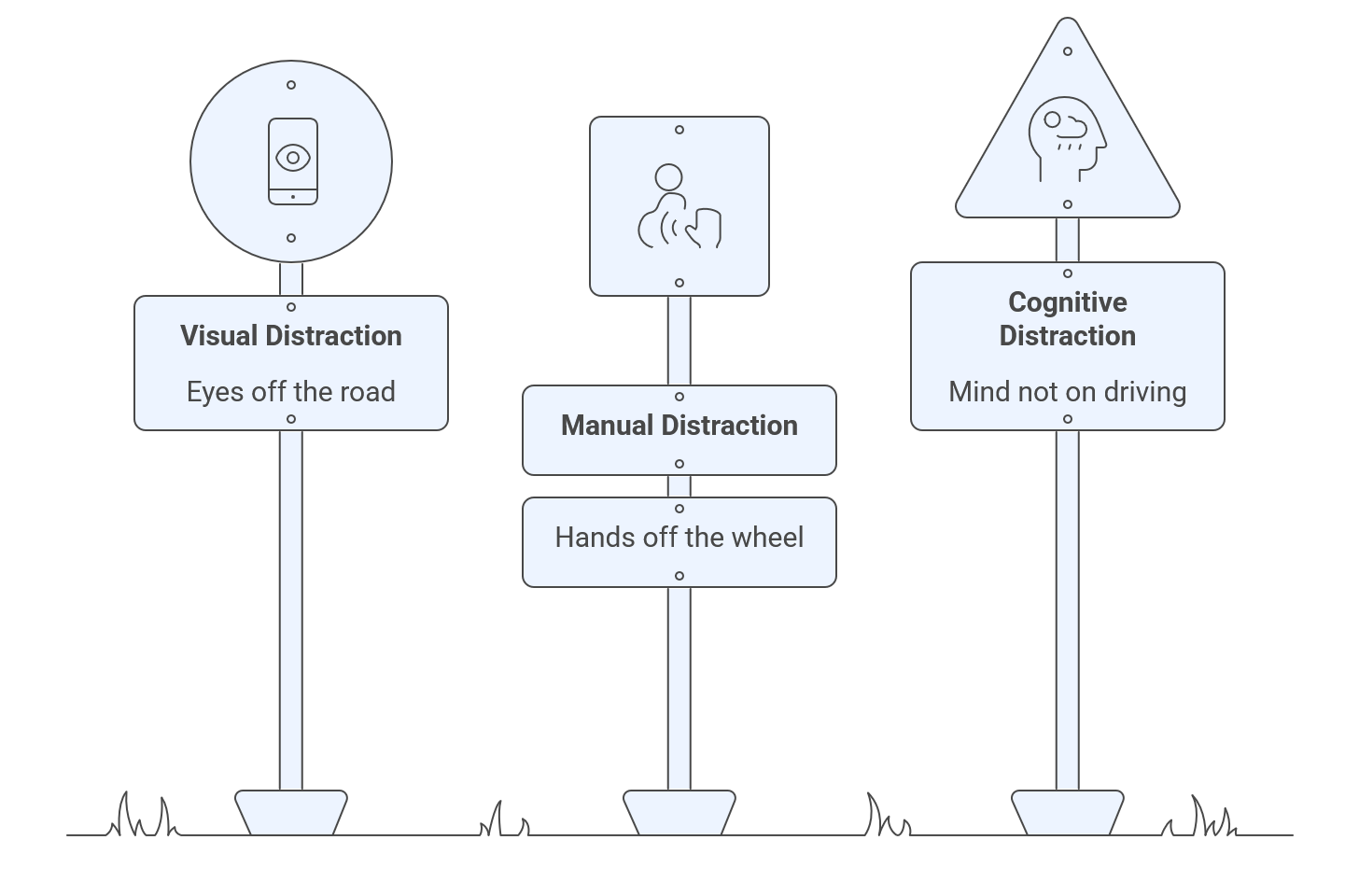
Table: Common Driver Distractions That Lead to Car Accidents
| Type of Distraction | Example Activities | How It Increases Crash Risk |
|---|---|---|
| Visual Distraction | Looking at a phone, checking GPS, reading a message | Eyes leave the road, reducing awareness of traffic and hazards |
| Manual Distraction | Texting, eating, adjusting the radio, reaching for objects | Hands leave the steering wheel, reducing vehicle control |
| Cognitive Distraction | Phone conversations, interacting with passengers, daydreaming | Driver’s attention shifts away from traffic conditions |
| Smartphone Use | Texting, social media, navigation apps | Combines visual, manual, and cognitive distraction simultaneously |
| In-Vehicle Technology | Touchscreens, infotainment systems, navigation inputs | Diverts attention while drivers attempt to operate complex controls |
Among all forms of driver distraction, texting while driving is widely considered the most dangerous because it involves visual, manual, and cognitive distraction at the same time. Even a few seconds spent reading or sending a message can prevent a driver from reacting to traffic conditions, increasing the likelihood of rear-end collisions, intersection crashes, and other serious accidents.
You can learn more about how texting contributes to crashes in our Texting While Driving Accident Guide.
Texting and Driving Accidents
Texting while driving is widely considered one of the most dangerous forms of distracted driving because it involves visual, manual, and cognitive distraction at the same time. When a driver reads or sends a text message, their eyes leave the road, their hands leave the steering wheel, and their attention shifts away from surrounding traffic. Even a few seconds of distraction can prevent a driver from noticing slowing vehicles, traffic signals, or other hazards that require an immediate response.
Safety research from the National Highway Traffic Safety Administration shows that reading or sending a text message typically takes about five seconds. At highway speeds of roughly 55 miles per hour, a vehicle can travel the length of an entire football field during that time without the driver watching the road. In real-world driving conditions, this loss of attention often leads to crashes where the distracted driver fails to react until it is too late.
Texting-related distraction commonly contributes to rear-end collisions, intersection crashes, and lane departure accidents. Because the distracted driver may not brake or react in time, these crashes can occur at full speed and result in serious injuries.
Who Is Liable for a Distracted Driving Accident in Michigan
In Michigan, a driver who causes a crash because they were distracted may be considered legally negligent. Drivers have a duty to operate their vehicles safely and remain attentive to traffic conditions. When a driver takes their eyes off the road to read a text message, interact with a phone, adjust a navigation system, or engage in other distractions, they may fail to notice slowing traffic, traffic signals, or other hazards. If that distraction leads to a collision, the driver may be held responsible for the injuries and damages that follow.
Although Michigan follows a No-Fault insurance system that provides certain benefits regardless of fault, determining liability is still extremely important. Establishing that another driver was distracted may allow an injured victim to pursue compensation through a third-party lawsuit for damages such as pain and suffering, excess medical expenses, and lost income beyond No-Fault limits.

How Distracted Driving Is Proven After a Crash In many distracted driving cases, the most important question is what the driver was doing in the moments before the crash. Investigators often examine phone records, witness statements, crash scene evidence, and accident reconstruction data to determine whether a driver was texting or otherwise not paying attention to the road. In one distracted driving case handled by our firm, the evidence showed that a driver who was texting failed to notice slowing traffic ahead and caused a serious crash that resulted in catastrophic injuries. The case ultimately resolved for $2.3 million, demonstrating how proving driver distraction can play a critical role in establishing liability.
Evidence is often needed to show that a driver was distracted and failed to react to traffic conditions. This information may come from multiple sources, including electronic records, witness testimony, and crash investigations conducted by law enforcement or accident reconstruction experts.
Evidence That May Help Prove Distracted Driving
| Evidence Type | How It Helps Establish Driver Distraction |
|---|---|
| Cell phone records | May show texting, calls, or app use at the time of the crash |
| Witness statements | Observers may report a driver looking down at a phone or device |
| Police reports | Officers may document driver admissions or signs of distraction |
| Crash reconstruction analysis | Experts can analyze braking, speed, and reaction time before impact |
| Vehicle data systems | Some vehicles record braking, steering, and acceleration data |
When a distracted driver fails to react to traffic conditions, the resulting collision can occur with little warning. Because these crashes often happen at full speed, they frequently lead to serious and sometimes life-altering injuries.
Common Injuries in Distracted Driving Accidents
Distracted driving crashes often occur because a driver fails to notice traffic conditions until it is too late to react. Unlike some other types of accidents where drivers attempt to brake or swerve before impact, distracted drivers may continue traveling at full speed when a collision occurs. This lack of reaction can significantly increase the force of impact and the likelihood of serious injuries. Victims of distracted driving accidents may suffer a wide range of injuries depending on the speed of the vehicles, the point of impact, and whether occupants were properly restrained. Some of the most common injuries include:
- Traumatic Brain Injuries (TBI) – Head trauma caused by sudden impact or violent motion during a collision.
- Spinal Cord Injuries – Damage to the spine that can lead to chronic pain, nerve damage, or paralysis.
- Whiplash and Neck Injuries – Soft tissue injuries caused by rapid back-and-forth movement of the neck.
- Broken Bones and Fractures – Common in the arms, legs, ribs, and collarbone during high-impact crashes.
- Internal Injuries and Organ Damage – Blunt force trauma can damage internal organs such as the lungs, liver, or spleen.
- Back Injuries and Herniated Discs – Disc injuries and spinal strain that may require long-term treatment.
- Severe Lacerations and Road Rash – Deep cuts caused by broken glass, metal, or debris during a crash.
- Psychological Trauma – Anxiety, PTSD, and emotional distress following a serious accident.
You can learn more about how these injuries occur and how they affect accident victims in our common car accident injuries guide.
Michigan No-Fault Insurance and Distracted Driving Claims
Michigan follows a No-Fault insurance system for car accidents, meaning injured drivers and passengers typically seek certain benefits from their own insurance company regardless of who caused the crash. These Personal Injury Protection (PIP) benefits may cover medical expenses, a portion of lost wages, and replacement services during recovery. However, determining that another driver was distracted can still be extremely important. If the victim suffers a qualifying serious injury under Michigan law, they may be able to pursue a third-party claim against the at-fault driver for damages that go beyond No-Fault benefits.
Compensation Available After a Distracted Driving Accident
| Type of Compensation | What It May Cover |
|---|---|
| Medical Expenses (PIP Benefits) | Hospital treatment, surgery, rehabilitation, and ongoing medical care |
| Lost Wages | A portion of income lost while recovering from accident-related injuries |
| Replacement Services | Household help for tasks the injured person can no longer perform |
| Pain and Suffering | Non-economic damages available through a third-party negligence claim |
| Future Medical Care | Long-term treatment costs for serious or permanent injuries |
To pursue compensation beyond No-Fault benefits, injured victims generally must prove that the distracted driver’s negligence caused the crash and that the injuries meet Michigan’s legal threshold for a serious impairment of body function. You can learn more about how fault is established in our how to prove negligence in a Michigan car accident page.
Legal Help After a Distracted Driving Accident in Michigan
Distracted driving accidents are often preventable, but proving that another driver was not paying attention to the road may require a careful investigation. Phone records, witness statements, crash scene evidence, and accident reconstruction analysis can all help establish whether a driver was texting or otherwise distracted at the time of the collision.
If you were injured in a distracted driving crash, understanding your rights under Michigan law is an important first step. You can learn more about your options and how accident claims work by exploring our guide to legal help after a Michigan accident.
Attorney Review
Legally reviewed by
Matthew R. Clark focuses exclusively on personal injury and wrongful death cases throughout Mid-Michigan. He graduated from Michigan State University College of Law and trained at The Geoffrey Fieger Trial Practice Institute. His practice includes serious car accident, no-fault insurance, and catastrophic injury claims, and he has recovered millions for injured clients while providing direct attorney-level representation from start to finish.