
Michigan car accident laws operate under a No Fault insurance system, meaning drivers typically turn to their own insurance for medical expenses and certain financial losses after a crash, regardless of who caused the accident. However, a lawsuit against the at fault driver is only allowed if the injury meets the legal threshold for serious impairment of body function, permanent disfigurement, or death under MCL 500.3135. Additional statutes govern insurance priority, comparative fault, and strict filing deadlines that can determine whether compensation is available.
Michigan car accident laws control how injury claims are evaluated, paid, and litigated after a crash. These statutes govern everything from insurance benefits and filing deadlines to fault allocation and compensation rights, and they often determine whether a case succeeds or fails before negotiations even begin. Because these rules operate together as a single legal framework rather than as isolated provisions, understanding how they interact is essential for anyone pursuing compensation or seeking legal help after a Michigan crash. The sections below explain the key statutes that shape Michigan accident cases, how courts interpret them, and how they affect real claims in practice.
Key Takeaways: Michigan Car Accident Laws
- Michigan follows a No Fault insurance system. After most crashes, drivers seek medical and wage loss benefits from their own Personal Injury Protection coverage rather than the at fault driver.
- You can only sue for pain and suffering in limited situations. Michigan law allows a lawsuit against the at fault driver only if the injury meets the serious impairment threshold defined in MCL 500.3135.
- Strict deadlines control accident claims. Most injury lawsuits must be filed within three years under MCL 600.5805, while No Fault medical benefits are limited by the one year back rule in MCL 500.3145.
- Fault can still affect compensation. Michigan uses a comparative negligence system, meaning damages may be reduced if an injured person is partially responsible for the crash.
- Insurance coverage and priority rules determine who pays benefits. Statutes such as MCL 500.3114 and the Assigned Claims provisions determine which insurer must provide No Fault benefits after an accident.
The following table summarizes the primary Michigan statutes that govern car accident claims. Each of these laws plays a distinct role in determining medical benefits, liability exposure, filing deadlines, and insurance obligations. The sections that follow provide detailed analysis of how these statutes function in real litigation.
| Statute | Legal Topic | Legal Function and Practical Effect |
|---|---|---|
| MCL 500.3101 | Mandatory no-fault insurance | Determines whether a vehicle is legally insured and whether statutory protections apply |
| MCL 500.3105 | PIP benefit eligibility | Defines when personal injury protection benefits are payable after a motor vehicle accident |
| MCL 500.3107c | PIP coverage elections | Defines available medical benefit limits and coverage tiers |
| MCL 500.3114 | Order of priority | Establishes which insurer is responsible for paying no-fault benefits |
| MCL 500.3145 | PIP timing rules | Limits recovery of medical expenses and sets statutory notice and filing requirements |
| MCL 500.3157 | Medical reimbursement limits | Restricts provider charges under the statutory fee schedule |
| MCL 500.3135 | Tort lawsuit threshold | Defines when an injured person may sue for non-economic damages |
| MCL 500.3135(3)(e) | Mini-tort vehicle damage claims | Allows limited recovery up to $3000 for vehicle damage from an at-fault driver |
| MCL 600.2959 | Comparative fault | Reduces damages based on a party’s percentage of responsibility |
| MCL 600.6304 | Allocation of liability | Governs how fault is distributed among multiple responsible parties |
| MCL 600.5805 | Filing deadline for injury lawsuits | Sets the statute of limitations for third-party personal injury claims |
| MCL 500.3145 | PIP back-bill limitation | Separately limits recoverable no-fault benefits regardless of lawsuit timing |
| MCL 257.622 | Accident reporting duties | Requires reporting certain crashes to law enforcement |
| MCL 257.619 | Duty to stop | Requires drivers to stop and provide identifying information after an accident |
| MCL 257.618 | Duty to render aid | Requires reasonable assistance to injured persons |
| MCL 500.3102 | Penalties for uninsured driving | Affects eligibility for benefits and legal recovery rights |
| MCL 500.3009 | Minimum liability coverage | Establishes required bodily injury liability insurance limits |
| MCL 500.3172 | Assigned claims eligibility | Provides access to benefits when no applicable insurer exists |

No-Fault Insurance Laws That Govern Medical Benefits
Michigan’s no-fault system is governed by a set of interrelated statutes that determine whether medical benefits are available, which insurer must pay them, and what limits apply to reimbursement. These laws function as a coordinated framework, not as isolated rules, and disputes often arise when insurers interpret them differently or attempt to shift responsibility under priority provisions. Because courts apply these statutes strictly, the outcome of a claim frequently depends on how they interact in a particular case. The sections below outline the primary no-fault laws that control medical benefits and explain how they operate in real accident claims.
MCL 500.3101 – Mandatory No-Fault Insurance Requirement
MCL 500.3101 requires the owner or registrant of a motor vehicle operated in Michigan to maintain no-fault insurance coverage, including personal injury protection, property protection insurance, and residual liability coverage. This statute establishes insurance as a legal prerequisite to operating a vehicle and serves as the foundation of Michigan’s no-fault system. Compliance with this requirement determines whether statutory benefits are available and whether certain legal limitations or penalties apply after a crash.
In practice, insurance status at the time of the collision can become a threshold issue that shapes the entire claim. Disputes often arise over policy lapses, cancellations, exclusions, or effective dates, particularly when coverage was recently issued or a premium payment was missed. When insurance compliance is contested, the case may turn less on how the accident occurred and more on whether valid coverage existed, making documentation of the policy’s status critically important.
MCL 500.3105 – When Personal Injury Protection (PIP) Benefits Apply
MCL 500.3105 defines when personal injury protection benefits are payable under Michigan’s no-fault system. The statute requires that accidental bodily injury arise out of the ownership, operation, maintenance, or use of a motor vehicle as a motor vehicle. This requirement establishes a causation standard that limits coverage to injuries sufficiently connected to motor vehicle use rather than any incident merely involving a vehicle. Courts evaluate whether the relationship between the injury and vehicle use is substantial enough to satisfy the statute.
In disputed claims, insurers frequently challenge whether this causation requirement is met, particularly in cases involving parked vehicles, loading activity, or injuries occurring near a vehicle but not directly caused by driving. These disputes often determine eligibility for benefits before issues of fault or damages are even considered, which makes factual evidence about how the incident occurred critically important.
MCL 500.3107c – PIP Coverage Elections and Benefit Limits
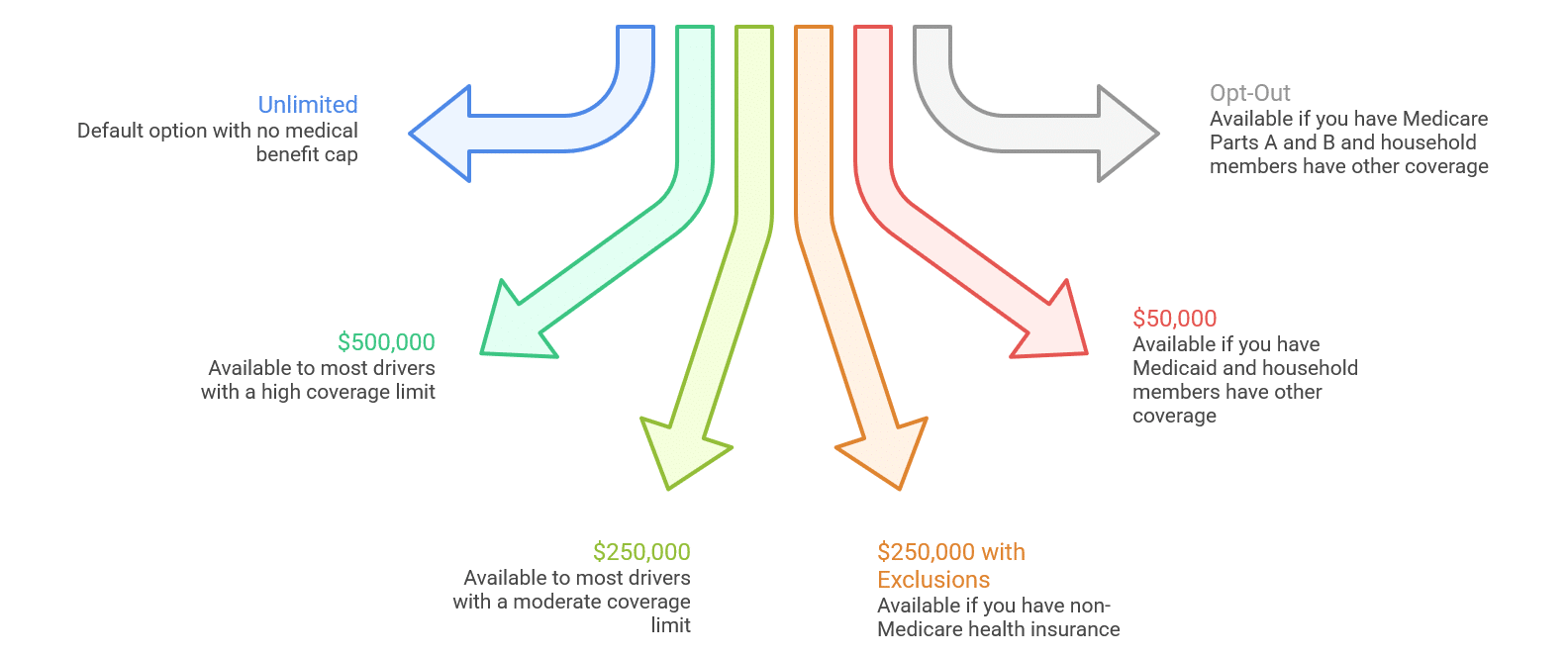
MCL 500.3107c governs the personal injury protection coverage levels drivers may select when purchasing Michigan no-fault insurance. Under this statute, policyholders may choose from several medical benefit limits, including approximately $50,000 for Medicaid-eligible individuals, $250,000, $500,000, or unlimited lifetime coverage. The selected level determines the maximum amount available for medical treatment after a crash and directly affects how much insurance protection exists if injuries are severe.
In practice, the elected coverage tier often becomes one of the most important factors in a claim. Individuals with lower selected limits may exhaust available benefits quickly after a serious injury, while those with higher or unlimited coverage may retain long-term access to medical care. Because the applicable limit is determined before an accident occurs, identifying the elected PIP level is often a critical early step in evaluating any Michigan auto injury claim.
MCL 500.3114 – Order of Priority: Which Insurance Company Pays First
MCL 500.3114 establishes the order of priority for determining which insurer is responsible for paying personal injury protection benefits after a motor vehicle accident. The statute sets out a hierarchy that generally requires an injured person to first seek benefits from their own no-fault insurer, followed by insurers of a spouse or resident relative in certain circumstances. Special priority rules apply to occupants of motor vehicles, pedestrians, motorcyclists, and individuals injured in commercial vehicle crashes. This statutory structure prevents multiple insurers from paying the same claim while designating a single carrier as legally responsible.
In real cases, priority disputes are common and can significantly delay benefit payments. Insurers frequently attempt to shift responsibility to another carrier by arguing that a higher-priority policy applies under the statute. These disputes often arise in cases involving household residency questions, company vehicles, out-of-state policies, or uninsured motorists. When priority is contested, identifying the correct insurer under MCL 500.3114 becomes a critical first step before medical benefits are paid.
Update: Because post-reform priority rules often direct uninsured pedestrians and non-occupants to the Michigan Assigned Claims Plan, which has applied a $250,000 medical benefits cap to applicable accidents since July 2, 2020, many recent cases now involve claims for “excess medical” damages. In current litigation, injured individuals frequently pursue at-fault drivers not only for pain and suffering but also for medical expenses that exceed available no-fault coverage, making priority analysis a critical early step in modern Michigan accident cases.

MCL 500.3145 – The One-Year-Back Rule and Notice Deadlines
MCL 500.3145 governs the time limits for seeking personal injury protection benefits under Michigan’s no-fault system. The statute requires an injured person to provide notice of injury to the insurer within one year of the accident and limits recovery of unpaid benefits to expenses incurred within the one-year period preceding the filing of a lawsuit. This provision functions as both a notice requirement and a damages limitation rule, meaning that even when a claim is otherwise valid, recovery may be restricted if statutory timing requirements are not satisfied.
In practice, this statute frequently becomes one of the most consequential issues in no-fault litigation. Insurers often rely on the one-year-back limitation to reduce the amount of medical expenses they must pay, particularly when treatment has been ongoing for an extended period before suit is filed. However, Michigan’s 2019 no-fault reforms added a tolling provision that can pause the one-year limitation period while a properly submitted claim for benefits remains pending and has not been formally denied. While this language was enacted in 2019, its full impact is only now being clarified through recent appellate decisions, including the 2025 case Spine Specialists of Michigan v MemberSelect, which addressed how courts evaluate denial language and the application of tolling. Because courts apply these timing rules carefully and often narrowly, disputes over notice, denial, and claimant diligence can substantially affect how much compensation ultimately remains recoverable.
MCL 500.3157 – Medical Fee Schedule and Provider Limitations
MCL 500.3157 governs how medical providers are reimbursed for treatment rendered to individuals receiving personal injury protection benefits under Michigan’s no-fault system. Following statutory amendments, this provision works in conjunction with the no-fault fee schedule to limit the amount insurers are required to pay for medical services, tying reimbursement rates to specified schedules rather than allowing unrestricted provider billing. The statute also restricts providers from charging or collecting amounts that exceed the permissible reimbursement limits established under the law.
In practice, disputes involving this statute often arise when providers bill amounts higher than what insurers believe the fee schedule allows, or when insurers reduce payments based on their interpretation of applicable reimbursement categories. These disagreements can affect whether treatment continues, whether balances are written off, or whether patients receive collection notices. As a result, issues under MCL 500.3157 frequently become central not only to benefit payment disputes but also to broader conflicts between providers, insurers, and injured individuals.
UPDATE: Although MCL 500.3157 generally limits medical reimbursements under Michigan’s no-fault fee schedule, courts have clarified that those caps do not apply retroactively to individuals injured before the June 11, 2019 reform. Decisions such as Andary v USAA and subsequent appellate rulings confirm that these legacy claimants may still recover reasonable and customary charges rather than post-reform percentage limits. Fee schedule amounts applicable to post-reform claims are also subject to periodic inflation adjustments, meaning reimbursement levels change over time and disputes may arise when insurers apply outdated figures.
Laws That Determine When You Can Sue the At-Fault Driver
Michigan’s no-fault system generally limits the ability to sue after a motor vehicle accident, but specific statutes define when an injured person may pursue a claim against an at-fault driver for damages such as pain and suffering or excess economic loss. These laws establish the legal threshold that must be met before a lawsuit is allowed, as well as how fault is evaluated and damages may be reduced. A closer look at who is at fault in a Michigan car accident often becomes central to determining whether a third-party claim may proceed. Because courts apply these statutory standards closely, disputes frequently focus on whether the legal requirements for bringing a lawsuit have been satisfied rather than solely on how the crash occurred.
MCL 500.3135 – Serious Impairment of Body Function Standard
MCL 500.3135 governs when an injured person may pursue a third-party lawsuit against an at-fault driver for non-economic damages such as pain and suffering. Under this statute, a plaintiff must establish that the injury resulted in death, permanent serious disfigurement, or a serious impairment of body function. The Michigan Supreme Court’s decision in McCormick v Carrier clarified that a serious impairment requires an objectively manifested impairment of an important body function that affects the person’s general ability to lead his or her normal life. The objective manifestation requirement means the injury must be observable or medically identifiable, and the “affects normal life” component focuses on how the impairment influences the person’s capacity to live in their customary manner.
In litigation, this statute is often the central battleground in a motor vehicle case. Insurers routinely argue that injuries do not rise to the level required under McCormick, particularly in cases involving soft tissue damage or disputed diagnostic findings. Courts evaluate medical records, physician testimony, work limitations, and changes in daily activities to determine whether the statutory threshold has been met. Because this standard controls whether a lawsuit may proceed at all, the serious impairment analysis frequently determines the overall value and viability of a claim.
MCL 500.3135(3)(e) – Michigan Mini Tort Law (Vehicle Damage Claims)
MCL 500.3135(3)(e) creates a limited exception to Michigan’s no-fault system that allows a vehicle owner to recover a portion of out-of-pocket property damage from an at-fault driver. Commonly referred to as the mini tort law, this provision permits recovery of vehicle repair costs not covered by insurance, up to the statutory maximum, provided the other driver is at fault for the collision. Unlike injury claims, which are restricted by the no-fault framework, this statute authorizes a direct claim against the responsible driver for unreimbursed vehicle damage.
In practice, mini tort claims often hinge on fault determination rather than the amount of damage. Disputes frequently arise when insurers disagree about who caused the crash or whether comparative fault should reduce recovery. Because payment depends on proving the other driver’s responsibility, evidence such as police reports, photographs, and witness statements can become decisive. Although the monetary cap limits exposure, disagreements under this statute are common and can still require formal legal action to resolve.
MCL 600.2959 – Comparative Negligence and Fault-Based Reduction
MCL 600.2959 establishes Michigan’s comparative negligence rule, which reduces a plaintiff’s recoverable damages in proportion to their percentage of fault for an accident. Under this statute, liability is allocated based on each party’s degree of responsibility, and a claimant may recover damages only to the extent their fault does not exceed the statutory threshold. This provision applies to third-party tort claims arising from motor vehicle accidents and works in conjunction with other liability statutes to determine the final amount of compensation that may be awarded.
In real cases, disputes over comparative fault can significantly affect case value and settlement negotiations. Insurers frequently argue that the injured person shares responsibility for the crash in order to reduce financial exposure, even when liability initially appears clear. Evidence such as crash reports, surveillance footage, vehicle data, and witness testimony is often used to assign percentages of fault. Because even a modest increase in assigned fault can substantially lower recoverable damages, how comparative negligence affects accident claims commonly becomes a central issue in contested accident cases.

MCL 600.6304 – Allocation of Fault Among Multiple Parties
MCL 600.6304 governs how fault is allocated when more than one party may be responsible for an injury. The statute requires the trier of fact to determine the percentage of total fault attributable to each person or entity that contributed to the harm, including parties, nonparties, and in some circumstances individuals who are not named defendants. This allocation framework ensures that liability reflects comparative responsibility rather than automatically imposing joint liability for the full amount of damages.
In motor vehicle litigation, this statute often comes into play when insurers attempt to shift blame to additional drivers, employers, vehicle owners, or even nonparties in order to reduce their financial exposure. Strategic use of fault allocation can substantially limit a defendant’s share of damages, particularly in multi-vehicle crashes. As a result, identifying all potentially responsible actors and evaluating how fault may be apportioned becomes a critical part of case strategy from the outset.
Statutes That Control Deadlines and Filing Requirements
Michigan car accident claims are governed by strict statutory time limits that determine how long a person has to take legal action or request benefits. These deadlines apply to both insurance claims and civil lawsuits, and they operate independently depending on the type of recovery being pursued. Missing a statutory deadline can permanently bar a claim regardless of how strong the underlying case may be, which is why timing rules often become decisive issues in accident litigation. The following statutes establish the primary filing and notice requirements that control when claims must be brought and how long injured parties have to protect their legal rights.
MCL 600.5805 – Three-Year Statute of Limitations for Injury Lawsuits
MCL 600.5805 establishes how long you have to file a lawsuit for personal injury claims arising from a motor vehicle accident. In most cases, an injured person must bring a lawsuit within three years from the date of the crash. This deadline applies to third-party tort claims, including those seeking compensation for pain and suffering or other non-economic damages. Once that statutory period expires, the right to pursue a civil case is generally barred regardless of how serious the injury may be.
In practice, this filing deadline often becomes a critical procedural issue, especially when medical treatment is ongoing or a person delays seeking legal guidance. Insurers are not required to notify claimants about how long they have to file, and settlement negotiations do not extend the statute of limitations. If a lawsuit is not formally filed before the deadline passes, courts will usually dismiss it, which is why understanding how this statute operates is essential to preserving the right to recover compensation.
MCL 500.3145 – PIP Filing and Back-Bill Limitations
MCL 500.3145 governs the time limits for pursuing personal injury protection benefits under Michigan’s no-fault system. The statute requires that written notice of injury be provided to the insurer within one year of the accident and limits recovery to benefits incurred within the one-year period preceding the filing of a lawsuit. Unlike the general three-year statute of limitations applicable to tort claims, this provision functions as both a notice requirement and a rolling damages limitation, meaning unpaid benefits can be permanently barred even if a lawsuit is later filed within the broader limitations period.
In practice, this statute frequently reduces the amount of recoverable medical expenses in long-running treatment cases. Insurers often rely on the one-year-back rule to limit payment for older bills when litigation is delayed.
Interaction Note: MCL 500.3145 operates differently from MCL 600.5805. The three-year statute of limitations governs when a tort lawsuit must be filed, while MCL 500.3145 controls notice requirements and limits recovery of PIP benefits regardless of the broader filing deadline. Confusing these statutes can result in lost benefits even when a separate lawsuit is still timely.
Driver Duties and Legal Responsibilities After an Accident
Michigan law imposes specific statutory duties on drivers involved in motor vehicle accidents, regardless of who caused the crash. These laws require motorists to stop, provide identifying information, assist injured individuals, and report certain collisions to law enforcement. Compliance is not optional, and failure to satisfy these obligations can result in civil liability, criminal penalties, or both. Because these statutes define what drivers must do immediately after an accident, they often become relevant in disputes involving fault, insurance coverage, or allegations of unlawful conduct following a collision.
MCL 257.622 – Reporting Requirements for Accidents Involving Injury or Damage
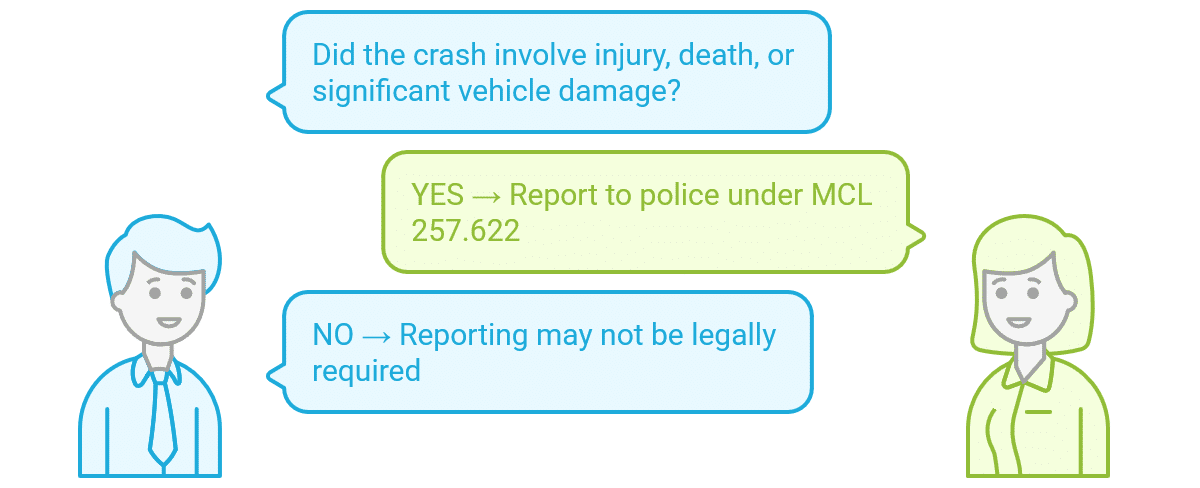
MCL 257.622 establishes when a motor vehicle accident must be reported to law enforcement in Michigan. The statute generally requires that crashes involving injury, death, or a specified level of property damage be reported, and it authorizes police officers to prepare official accident reports documenting the circumstances of the collision. These reports typically include driver information, vehicle details, statements from involved parties, and an officer’s observations, all of which can become part of the evidentiary record in insurance claims or litigation.
In practice, accident reports prepared under this statute often play a significant role in determining how claims are evaluated. Insurers frequently rely on these reports when assessing liability, and attorneys commonly use them as foundational evidence when investigating a case. Disputes may arise if a report contains inaccuracies, conflicting statements, or incomplete information, which can make early review of the report an important step in protecting a claimant’s legal position.
MCL 257.619 – Duty to Stop and Provide Information
MCL 257.619 requires a driver involved in a motor vehicle accident to immediately stop at the scene and provide identifying information to other parties involved. The statute generally obligates the driver to disclose their name, address, vehicle registration information, and, upon request, their driver’s license. This duty applies regardless of who caused the collision and is intended to ensure that all parties have the information necessary to address injuries, property damage, and insurance claims arising from the incident.
In real cases, violations of this statute can significantly affect both liability analysis and legal exposure. When a driver leaves the scene without providing the required information, it may lead to criminal charges and can also influence how insurers and courts evaluate fault or credibility. Allegations that a driver failed to comply with these obligations often become an important factor in disputed accident claims, particularly when evidence is limited or witness accounts conflict.
MCL 257.618 – Duty to Render Aid
MCL 257.618 imposes a legal obligation on drivers involved in an accident resulting in injury to provide reasonable assistance to injured persons. This duty generally includes making a good-faith effort to secure medical care when needed, such as arranging transportation or contacting emergency services. The statute reflects Michigan’s policy that drivers must take affirmative steps to help injured individuals rather than leaving them without assistance following a crash.
In practice, compliance with this requirement can become relevant in both criminal and civil proceedings. Failure to render aid may expose a driver to legal penalties and can also influence how insurers and courts evaluate conduct after the accident. In disputed cases, evidence regarding whether a driver attempted to assist injured parties can affect credibility assessments and may be considered alongside other facts when determining liability or damages.
Insurance Compliance Laws That Affect Legal Rights
Michigan’s no-fault system conditions many legal rights and protections on whether a driver is properly insured at the time of a crash. Certain statutes govern minimum coverage requirements, penalties for failing to maintain insurance, and how claims are handled when no applicable policy exists. These laws can directly affect eligibility for benefits, the ability to recover damages, and which insurance source may ultimately be responsible for payment. Because insurance status often becomes a threshold issue in accident claims, these provisions frequently play a decisive role in determining how a case proceeds.
MCL 500.3102 – Penalties for Driving Without Insurance
MCL 500.3102 addresses the legal consequences of operating a motor vehicle without the no-fault insurance required under Michigan law. The statute establishes that failure to maintain mandatory coverage is a violation that can result in statutory penalties, including fines and other legal sanctions. Beyond criminal or civil penalties, the provision reinforces the requirement that insurance be in effect as a condition of lawful vehicle operation and functions as an enforcement mechanism supporting the broader no-fault framework.
In real accident cases, uninsured status can have significant legal consequences that extend beyond traffic penalties. Drivers who are not properly insured may face restrictions on recovering certain damages after a crash and may encounter challenges when attempting to access benefits that would otherwise be available under the no-fault system. Because insurance compliance is often investigated early in a claim, disputes about coverage status can quickly become a central issue that shapes how a case proceeds.
MCL 500.3009 – Required Minimum Liability Insurance Limits
MCL 500.3009 establishes the minimum bodily injury liability insurance limits that must be included in a Michigan motor vehicle policy. The statute requires policies to provide coverage of at least the statutory minimum amounts for injury or death arising from a single accident, subject to the limits in effect under current law. These required liability limits apply to claims brought against a driver who is legally responsible for causing injuries to others and operate separately from personal injury protection benefits available under the no-fault system.
In practice, the liability limits required by this statute often define the maximum insurance recovery available from an at-fault driver’s policy. When injuries are severe, claims can exceed those limits, making coverage amounts a critical factor in evaluating case value and settlement strategy. Disputes may also arise regarding policy interpretation, stacked coverage, or the applicability of additional insurance sources, which can significantly affect how much compensation is ultimately recoverable.
MCL 500.3172 – Michigan Assigned Claims Plan Eligibility
MCL 500.3172 governs eligibility for benefits through the Michigan Assigned Claims Plan, which provides a mechanism for obtaining personal injury protection benefits when no applicable no-fault insurance policy is available. This statute applies in situations where an injured person has no identifiable insurer in the statutory order of priority, such as when no household policy exists, no vehicle insurer applies, or coverage cannot otherwise be located. The provision ensures that individuals injured in motor vehicle accidents are not automatically left without access to medical and wage loss benefits solely because no traditional insurer can be identified.
In practice, eligibility disputes under this statute often focus on whether another insurer should have priority responsibility. The Michigan Assigned Claims Plan functions as a payer of last resort, so insurers frequently challenge applications by asserting that a higher-priority policy exists. These cases commonly involve detailed investigations into household residency, vehicle ownership, or policy availability, and the outcome can determine whether benefits are paid at all and which entity ultimately bears financial responsibility.
How These Statutes Work Together in Actual Cases
Michigan car accident claims are usually controlled by several statutes at once, and the outcome often depends on how those laws interact rather than on any single rule alone. The following examples show how different Michigan statutes can combine to affect the same case:
- An injured driver may receive medical benefits under MCL 500.3105 but still be unable to sue for pain and suffering unless the injury meets the threshold required by MCL 500.3135.
- A lawsuit filed within the three-year deadline under MCL 600.5805 can still lose reimbursement for older medical bills because MCL 500.3145 limits recovery to expenses incurred within one year before suit.
- An insurer may delay payment while investigating coverage under MCL 500.3101 or determining priority under MCL 500.3114, even when fault for the crash appears clear.
- Damages may be reduced under MCL 600.2959 or allocated among multiple parties under MCL 600.6304 if the injured person is found partially responsible.
In practice, Michigan accident claims are often decided by how these statutes operate together, which is why understanding their combined effect is just as important as understanding any one law on its own.
Leading Court Decisions That Shape Michigan Auto Law
Michigan’s auto accident statutes are interpreted and applied through judicial decisions that define how courts evaluate injury claims, insurance disputes, and liability questions. Several appellate rulings play a central role in shaping how Michigan’s no-fault and tort systems function in real cases.
- McCormick v Carrier established the modern standard for proving a serious impairment of body function, holding that an injured person must show an objectively manifested impairment of an important body function that affects their general ability to lead a normal life. This decision now governs whether many injury lawsuits are legally permitted to proceed.
- Kreiner v Fischer previously adopted a narrower interpretation of the injury threshold before its reasoning was later rejected, illustrating how judicial interpretation can significantly affect access to the courts in motor vehicle injury cases.
- Patrick v Turkelson addresses liability and fault allocation principles that continue to influence how courts evaluate responsibility in disputed accident claims, particularly where multiple parties may share blame.
- Covenant Medical Center v State Farm held that healthcare providers do not possess an independent statutory cause of action for personal injury protection benefits, fundamentally altering how medical billing disputes are litigated within Michigan’s no-fault system.
- Spine Specialists of Michigan PC v MemberSelect clarified how courts interpret the tolling provision in MCL 500.3145, reinforcing that the one-year-back limitation may be paused while a claim for benefits remains pending without a formal denial. The decision underscores that recent appellate rulings continue to shape how statutory timing rules are applied in modern no-fault litigation, particularly in disputes over unpaid medical expenses.
- Andary v USAA confirmed that post-2019 no-fault fee schedule caps cannot be applied retroactively to individuals injured before the reform took effect, preserving entitlement to reasonable and customary charges for legacy claimants.
Together, these decisions demonstrate that Michigan auto accident law is shaped not only by statutory language but also by the courts that interpret and apply it. In many cases, the controlling appellate precedent can be just as important as the statute itself.
Mistakes That Can Undermine an Otherwise Valid Claim
Even when an accident claim appears strong on its facts, procedural and statutory missteps can significantly limit recovery or prevent a case from moving forward at all. Michigan’s no-fault system imposes strict requirements that govern notice, documentation, eligibility, and legal deadlines, and courts generally enforce these rules as written. Many otherwise valid claims are weakened not because the injury or liability is disputed, but because a technical requirement was overlooked or misunderstood during the early stages of the claim process.
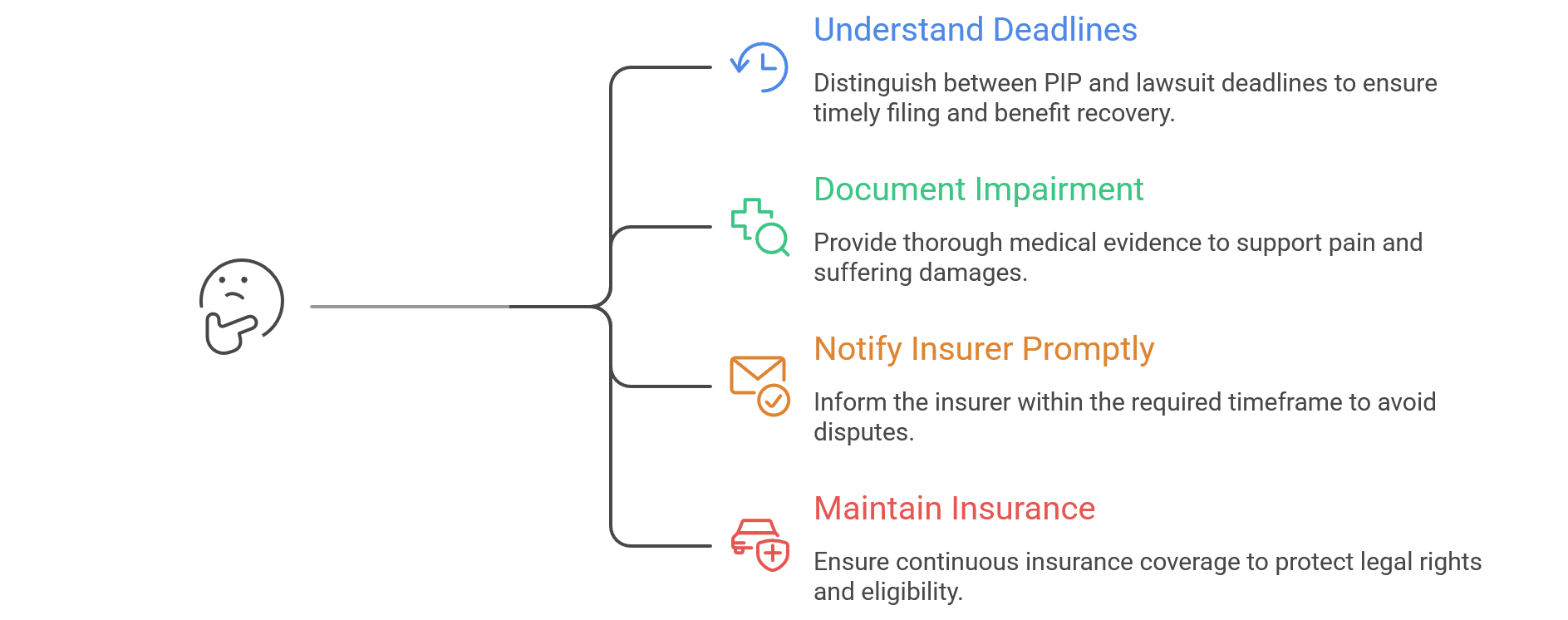
- Confusing the PIP deadline with the lawsuit deadline can result in lost benefits even when a case is filed on time, because the one-year limitation on recoverable no-fault benefits operates separately from the three-year statute of limitations for injury lawsuits.
- Failing to document the seriousness impairment may prevent a claim from meeting the legal threshold required to pursue pain and suffering damages, since courts rely heavily on medical evidence and proof of how the injury affects daily life.
- Waiting too long to notify an insurer can create disputes about compliance with statutory notice requirements, which insurers may use as a basis to delay or deny payment.
- Driving without insurance and assuming legal rights remain unchanged can lead to significant restrictions on recovery, as insurance status often affects eligibility for certain claims and protections under Michigan law.
Understanding these pitfalls is important because claim outcomes are often shaped by how statutory requirements are handled in the early stages. Careful attention to deadlines, documentation, and insurance status can make a meaningful difference in both the strength and value of a case.
Why Understanding Michigan’s Auto Laws Matters After a Crash
Michigan’s auto accident laws can be complicated because they are made up of several statutes, court decisions, and procedural rules that all work together to determine how a claim is handled. In many cases, the outcome doesn’t depend on just one law but on how multiple rules interact, including those that control benefits, deadlines, fault, and compensation. Courts apply these requirements strictly, so even small misunderstandings can affect your rights. That’s why it’s important to understand how Michigan accident laws work, how they fit together, and what steps need to be taken after a crash to protect your claim and accurately evaluate your options.
Frequently Asked Questions About Michigan Car Accident Laws
What is Michigan’s no fault law and what does it actually cover after a crash?
Michigan’s no fault law requires drivers to use their own insurance for medical expenses and certain financial losses after a crash, regardless of who caused the accident. Under MCL 500.3105 and related provisions, personal injury protection benefits can cover medical bills, wage loss, replacement services, and certain survivor benefits. However, the system limits when you may sue the at fault driver for pain and suffering unless the injury meets the statutory threshold. The no fault framework separates insurance benefits from fault based lawsuits.
Do I always go through my own insurance first for medical bills and lost wages?
In most cases, you must first seek personal injury protection benefits from your own no fault insurer. MCL 500.3114 establishes the order of priority, which typically requires an injured person to claim benefits from their own policy or that of a resident relative. Exceptions apply in certain commercial vehicle or special occupancy situations. If the correct insurer is disputed, payment may be delayed until priority is resolved.
Which insurance company pays PIP benefits if I was a passenger or a pedestrian?
The responsible insurer is determined by Michigan’s statutory order of priority rules. Under MCL 500.3114, passengers usually seek benefits from their own insurer or that of a resident relative, while pedestrians may seek coverage from the insurer of the vehicle involved in the crash. If no applicable insurer can be identified, benefits may be pursued through the Michigan Assigned Claims Plan under MCL 500.3172. Priority disputes are common and can significantly delay payment.
What is the one year back rule and how can it reduce what an insurer has to pay?
The one year back rule limits recovery of unpaid PIP benefits to expenses incurred within one year before a lawsuit is filed. This rule is contained in MCL 500.3145 and operates as a rolling limitation on damages, even if the overall claim is valid. If a person delays filing suit, older medical bills may become unrecoverable. Courts apply this limitation strictly, making timing critical in no fault cases.
How long do I have to file a lawsuit after a Michigan car accident?
In most cases, you have three years from the date of the crash to file a personal injury lawsuit. This deadline is established under MCL 600.5805 and applies to third party claims seeking pain and suffering or excess economic damages. If a lawsuit is not filed within that three year period, courts will generally dismiss it regardless of the injury’s severity. Settlement negotiations do not extend this deadline.
When can I sue the at fault driver for pain and suffering in Michigan?
You may sue an at fault driver for pain and suffering only if your injury meets Michigan’s statutory threshold. Under MCL 500.3135, you must show death, permanent serious disfigurement, or a serious impairment of body function. This requirement limits access to the civil court system in most accident cases. If the threshold is not met, recovery is generally restricted to no fault benefits.
What qualifies as a serious impairment of body function under Michigan law?
A serious impairment of body function is an objectively manifested impairment of an important body function that affects a person’s general ability to lead a normal life. This standard was clarified by the Michigan Supreme Court in McCormick v Carrier. The impairment must be medically identifiable and must meaningfully influence the person’s daily activities or lifestyle. Courts evaluate medical evidence, work restrictions, and life changes when applying this test.
What is comparative negligence and how does it reduce a settlement or verdict?
Comparative negligence reduces a plaintiff’s recovery based on their percentage of fault. Under MCL 600.2959, damages are diminished in proportion to the injured person’s assigned responsibility for the crash. If a person is found more than 50 percent at fault, recovery for non economic damages may be barred. Even smaller fault allocations can significantly reduce the value of a claim.
What is the Michigan mini-tort and how much can I recover for vehicle damage?
Michigan’s mini tort law allows limited recovery of out of pocket vehicle damage from an at fault driver. Under MCL 500.3135(3)(e), recovery is capped at the statutory maximum for unreimbursed repair costs not covered by insurance. Fault must be proven to collect under this provision. Disputes often focus on liability rather than the amount of damage.
What happens if I was driving uninsured at the time of the crash?
Driving without required no fault insurance can significantly limit your legal rights. Under MCL 500.3102 and related provisions, uninsured drivers may be barred from recovering certain damages and may face statutory penalties. Insurance status often becomes a threshold issue that affects eligibility for benefits. Courts enforce these restrictions strictly.
Do I need a police report to protect my Michigan car accident claim?
Michigan law requires reporting certain crashes involving injury, death, or substantial property damage. MCL 257.622 governs accident reporting duties and authorizes law enforcement to prepare official reports. While a police report is not always legally required to file a claim, it often becomes critical evidence in insurance disputes. Insurers frequently rely on these reports when evaluating fault.
What should I avoid saying to an insurance adjuster after a crash?
You should avoid admitting fault, minimizing injuries, or speculating about how the crash occurred. Statements made to an adjuster can later be used to assign comparative fault or challenge injury severity. Insurers evaluate recorded statements closely and may use inconsistencies to reduce exposure. Clear, accurate communication and documentation are essential in the early stages of a claim.

Attorney Review
Legally reviewed by
Matthew R. Clark focuses exclusively on personal injury and wrongful death cases throughout Mid-Michigan. He graduated from Michigan State University College of Law and trained at The Geoffrey Fieger Trial Practice Institute. His practice includes serious car accident, no-fault insurance, and catastrophic injury claims, and he has recovered millions for injured clients while providing direct attorney-level representation from start to finish.